ADVERTISEMENT
Anthony. I let it ring. Then Rachel.
Another voicemail. Text message. Margaret, call me.
There’s been a misunderstanding with the bank. Three minutes later:
Sam says you declined the guaranty.
I’m sure this is emotional spillover from last night. Let’s be adults. I stared at that last line long enough to feel my pulse in my ears.
I sat down at the kitchen table, opened a fresh legal pad, and wrote in neat block letters:
Guarantee. Bridge loan in 2021. Catering deposit for wedding.
What I received:
Silence. Jokes. Assumptions.
Not Anthony. My sister, Louise. Louise lived in Highlands Ranch, wore bright lipstick like armor, and had the sort of face that only ever looked sincere when she was angry.
She walked in carrying a Costco pumpkin pie, and one glance at me told her enough. “Oh, honey,” she said. “What did he do?”
Which meant someone else had. I made coffee. She cut pie no one touched.
That Rachel was hysterical. That Anthony might lose vendor relationships if the bank tightened terms.
That one cousin had actually used the phrase elderly overreaction. Louise listened while I told her about the bank, the review, the numbers, the years of signatures. When I finished, she put her fork down so hard it rang against the plate.
“They knew?” she said. “Not everyone.”
“No.” She shook her head. “Don’t do that thing where you protect them with grammar.
Did they know you were on the hook?”
“Yes.”
“And did they laugh at you while you were carrying their risk?”
“Yes.”
She leaned back. “Then let the floor open under him.”
I laughed then, unexpectedly and briefly. It felt rusty.
Louise glanced at the folded napkin beside my legal pad. “What’s that?”
“I brought it home from dinner.”
She touched the edge of the fabric with one finger. “Good,” she said.
“Keep it. People like Anthony survive by making you doubt the moment after it happens.”
She was right. The first bruise in a family is usually confusion.
Rachel called at 4:36. I answered because I knew if I did not, she would come over in tears and Anthony would drive her, which was more company than I could bear. “Mom?”
Her voice sounded thin and breathless, like she had been crying in a bathroom and had only just stopped long enough to dial.
“Yes.”
“What did you do?”
I closed my eyes. Straight to that. “I declined to renew the guaranty,” I said.
A long silence. Then, “Anthony says the bank can cut the line. He says payroll’s due Friday.”
“Then he should have thought about that before treating me like the entertainment after pot roast.”
“Mom—”
“No.
Don’t start with that tone. Not today.”
I kept my voice level because one of us had to. “Did you know the guaranty was four hundred eighty thousand dollars?”
Another silence.
Louder this time. “I knew you’d helped,” she said. “That is not what I asked.”
“No,” she whispered.
“Did you know the renewal required my signature this week?”
“No.”
“Did you know he submitted a personal statement to the bank while carrying a luxury vehicle lease he can’t support without my credit standing behind him?”
“Mom, please.”
“That sounds like no too.”
Her breathing sharpened. “I said please because I’m trying to understand why this is all happening at once.”
I almost said it isn’t at once. It’s years.
But her voice stopped me. There was fear in it now, yes, but underneath the fear was something else. Ignorance.
Real ignorance, not the strategic kind people perform after they are caught. I sat down slowly. “Rachel,” I said, and softened despite myself, “last night your husband insulted me in front of a room full of people.
You looked at your plate and let him. This morning I found out he has been walking around as if my support is guaranteed. Those are not separate events.”
“I didn’t think—”
“I know.”
She made a sound like she was swallowing tears.
“What happens now?”
“Now,” I said, “Anthony speaks to his bank, his accountant, and his own conscience. In that order.”
“Can’t you just give him a week?”
I looked at the napkin. At the list on the legal pad.
At the years compressed into paperwork. “No,” I said. That was the first time in my adult life I had said no to my daughter and not softened it with a reason she could survive inside.
It landed between us like weather. By Wednesday, the story had left our family and entered the outer rings of social life, which is when trouble becomes truly American. Not private grief.
Reputation. Rachel called from the parking lot of a Safeway because she did not want Anthony hearing. One of Anthony’s vendors had gotten nervous.
His office manager had heard from someone’s brother-in-law at the bank that the line might be repriced. A subcontractor had texted another contractor. By lunch, two people at their church had asked Rachel whether everything was all right at home in that soft predatory way people have when they are begging for details while pretending to offer concern.
“He told people you pulled support over a joke,” Rachel said. “Did he mention the loan amount?”
“No.”
“Did he mention the repeated renewals?”
“No.”
“Did he mention that he told the bank my signature was a formality?”
A beat. “No.”
“Then he is not telling people what happened.
He is marketing himself.”
She went quiet. That had always been Anthony’s instinct. Not to solve.
To frame. He framed kitchen remodels with mood boards. He framed debt as growth.
He framed impulsiveness as vision. He framed criticism as negativity and basic respect as people being too sensitive. By afternoon, I had three voicemails from relatives I did not particularly like.
One from Cousin Diane reminding me that marriages are fragile under financial stress. One from Anthony’s older brother saying, “You know how he jokes.”
And one from a woman at church who never once called after Howard died but had apparently found time now to tell me forgiveness was important. I deleted all three.
At six that evening, Samuel Grant called. “Committee met,” he said. “They are willing to continue a reduced facility if Mr.
Bennett pledges additional collateral and accepts revised pricing. Otherwise the line will amortize down over ninety days.”
“Has he agreed?”
“He asked for forty-eight hours.”
I nearly laughed. Forty-eight hours.
Two days to solve what I had been carrying for years. “Thank you for telling me,” I said. He hesitated.
“I want to be careful here, but you should know he seemed surprised by the seriousness of the review.”
“Samuel,” I said, “men are often surprised by the seriousness of consequences when women stop cushioning them.”
He gave a quiet exhale that might have been a laugh. “Yes, ma’am.”
After we hung up, I stood at the kitchen sink for a long time watching dusk collect in the yard. Then my phone buzzed with a family group text someone had revived for the purpose of disaster.
Anthony: We are working through some business complications and would appreciate privacy. Louise: Privacy is a lovely word for “we assumed Margaret would absorb the hit.”
No one answered her. But they all read it.
Rachel came to my house Thursday morning without Anthony. I knew by the way she parked crooked in the driveway that she had been crying. She came in carrying no purse, no coffee, no performance.
Just herself, which was rarer than it should have been. For a moment, standing there in my foyer with her mascara faintly smudged and her wedding ring twisted halfway around her finger, she looked almost exactly like the little girl who used to get stomachaches before school picture day. “I need the truth,” she said.
“Then sit down.”
We went to the kitchen. I made tea because that is what my hands do when there is pain in the room and nowhere obvious to put it. I set the manila folder between us.
“This is what you’re married to,” I said. Not Anthony. The folder.
Paperwork has a way of humbling drama. I walked her through it page by page. The original line.
The renewals. The increases. The side note about the annual signature.
The current draw. The past-due receivables. The four hundred eighty thousand dollars.
She read in silence for several minutes, one hand covering her mouth. Then she said, “He told me it was just a backup signature in case the bank got nervous.”
“It was a backup signature,” I said. “Mine.
For years.”
Tears filled her eyes, but she blinked them back. “Why didn’t you tell me?”
The question should have angered me. Instead, it just exhausted me.
“Because every time I tried to bring up money, you shut down. Because every time he said don’t worry, you treated that as information instead of avoidance. Because after your father died, I made a religion out of preventing crisis, and religions are hard to quit.”
She flinched.
Then she looked at the napkin on the counter. I had washed it the night before. The wine spot had faded but not disappeared.
“What is that doing here?” she asked. “I brought it home from dinner.”
Her face changed. Not confusion.
Recognition. She remembered. I saw the entire scene travel through her body in reverse: the laugh, the look at the plate, my chair scraping back, my coat in the hallway, the front door closing without anyone following me.
“I thought if I didn’t react,” she whispered, “it would pass.”
“Pass for whom?”
She stared at the table. That was the moment the story changed. Not when I went to the bank.
Not when committee met. Right there, in my kitchen, when my daughter finally heard the sentence she had been living inside. Pass for whom?
“For him, I guess,” she said. “And for you?”
“I don’t know.” Her voice shook. “I’ve been smoothing things over so long I don’t even know when I started.”
There it was.
The inheritance I never meant to give her. Not my steadiness. My silence.
Rachel covered her face with both hands. “He told me you were punishing him because you never liked how independent he is.”
I let that sit for one breath. Then another.
“Rachel,” I said, “men who depend on women’s money do not get to describe themselves as independent.”
She laughed once through her tears, a broken startled sound. Then she started crying for real. I went around the table and held her while she leaned into me, her shoulders shaking like they did when she was eleven and her best friend moved away.
“I’m so ashamed,” she said. “No,” I told her. “Be angry first.
Shame is only useful after anger tells you where the injury is.”
She pulled back and looked at me. “He’s been blaming me since Monday. He says I should have managed the dinner better.
He says if I had just redirected the conversation, you wouldn’t have gotten offended.”
I felt something cold pass through me. “Offended,” I repeated. She nodded.
Not sorry. Not frightened. Not responsible.
Just offended. I took the folder back from her and closed it. “Then you know what kind of conversation you need to have with your husband,” I said.
That afternoon, for the first time in their marriage, Rachel went home not to repair Anthony’s mood but to confront it. And for the first time in mine, I did not rush behind my daughter to keep her from the storm. I did not hear from Anthony that day.
Or Friday morning. Which told me more than any apology would have. If he had been merely embarrassed, he would have called immediately and performed humility.
Silence meant calculation. Silence meant he was still deciding whether contrition or pressure would serve him better. At 2:05 Friday afternoon, Rachel texted:
He accepted the restructure.
They cut the line. Higher rate. He has to pledge the second truck and the warehouse equipment.
A minute later:
He’s furious. Then:
I told him I’m furious too. I looked out my kitchen window at the little strip of winter-yellow grass along the fence and felt, not joy, but a clean hard relief.
The number had changed shape. $480,000 had been the weight I carried. Now it was the amount he had lost access to because he mistook dependence for entitlement.
Louise came over that evening with takeout from a Thai place in Belmar and the kind of curiosity sisters only barely disguise as support. “Well?” she said before she had even taken her coat off. “He took the restructure.”
“Meaning?”
“Meaning the bank didn’t close him.
It just stopped pretending I was part of his business model.”
Louise sat down and grinned like a woman watching a porch light finally come on across the street. “Good.”
We ate pad see ew out of white containers and she told me I looked ten years younger, which was rude but affectionate. When I filled her in on Rachel’s visit, she sobered.
“She didn’t know?”
“Not enough.”
Louise stirred noodles around with her chopsticks. “That’s not an excuse.”
“No.”
“But it matters.”
“Yes.”
That was the terrible thing about family. Intent mattered.
So did impact. So did pattern. You had to hold all three at once or become one of those people who confuse love with bookkeeping.
At nine, after Louise left, I walked through the house turning off lamps. When I passed the den, I saw the napkin folded on top of the file cabinet and stopped. I almost threw it away.
Instead, I picked it up, pressed it once between my hands, and set it back down. Some evidence deserves to remain visible until the lesson settles. Saturday night was the worst of it.
Not because anything dramatic happened. Because nothing did. No calls.
No emergencies. No shouted demands on my porch. Just the long empty stretch after a boundary, when a woman who has spent her whole life being useful begins to wonder whether usefulness was the only language anyone ever loved in her.
I made soup and did not eat it. I watched half a detective show and absorbed none of it. I opened a cabinet for a mug and found Howard’s instead, the thick white one with the chipped handle, and stood there with tears rising so fast it took my breath.
I missed him with sudden animal force. Not because he would have fixed this. Howard had his own blind spots.
He disliked conflict so much he could treat it like bad weather and simply hope it moved east. But he had one gift Anthony never managed to imitate. He was never cruel for sport.
I sat at the kitchen table with Howard’s mug in front of me and let myself think the thoughts I had been avoiding all week. What if Rachel stays with him no matter what? What if this tears my family in half?
What if the cousins are already calling me vindictive over potato salad somewhere? What if I am too old to rebuild my place at the table after walking away from it? Then the worst one.
What if the only reason they invited me at all was because my name could still steady a bank file? I put both hands flat on the table and breathed until the room stopped tilting. Then I took out the legal pad and wrote one sentence beneath my list.
If they loved my usefulness more than they loved me, then I have not lost love. I have identified an arrangement. That was ugly.
And it was true. Around ten, Rachel called. I almost did not answer.
But I did. “Mom?”
Her voice was low, careful. “I just wanted you to know I’m staying at the house tonight because Lily’s asleep and I’m not going to drag her out, but Anthony and I are not okay.”
Lily was my granddaughter, seven years old, all elbows and opinions and missing front teeth.
The mention of her softened everything in me at once. “Is he shouting?” I asked. “No.”
“Has he been drinking?”
“No.”
“Are you safe?”
A pause.
“Yes.”
Not a perfect yes. But a real one. “He said,” Rachel continued, “that you embarrassed him professionally.”
I stared at the dark window over the sink.
“And what did you say?”
“I said he embarrassed himself at dinner before any banker got involved.”
I let out a breath I did not know I was holding. Then she added, “I also asked him why he kept telling me everything was under control when he knew the renewal depended on you.”
“And?”
“He said he didn’t want me to worry.”
There it was again. The national anthem of irresponsible men.
I don’t want you to worry. Meaning: I want you uninformed enough to remain useful. “Mom,” Rachel said softly, “I think I built my marriage around not asking follow-up questions.”
I swallowed hard.
“A lot of women do.”
“But you don’t anymore.”
No. I looked at the napkin on the file cabinet through the den doorway. White cloth.
Faint stain. Proof. “No,” I said.
“I don’t.”
Anthony came to my house the following Tuesday at 3:20 in the afternoon. If you had told me beforehand he would show up, I would have pictured anger. A hard jaw.
Aggressive politeness. Maybe flowers bought by a man who thinks arrangements can do emotional labor for him. Instead, he stood on my porch alone, coat unbuttoned, hair windblown, looking not broken exactly but reduced.
Consequences had taken the shine off him faster than age ever could. I opened the door but did not invite him in. He shifted his weight once and said, “I owe you an apology.”
That sentence has carried many lies in human history.
I knew that. He knew I knew it. “What for?” I asked.
His face changed almost imperceptibly. The question forced specificity, and specificity is where bad men weaken. “For what I said at dinner.”
“What exactly did you say?”
He looked away toward the birch tree in my yard, then back at me.
“I made a joke about your eating. And I’ve made other comments before that were disrespectful.”
“Disrespectful,” I repeated. “Yes.”
“That’s a polished word.
Try a plainer one.”
He swallowed. “Cruel.”
There it was. A cold little satisfaction moved through me, not because the word healed anything, but because I had finally made him say it where no audience could save him.
“And?” I said. “And I took your support for granted.”
“Financially?”
“Yes.”
“Socially?”
He hesitated. “Yes.”
“Emotionally?”
That took longer.
“Yes.”
I studied him. There are moments in a woman’s life when she can see with total clarity whether a man is sorry for what he did or sorry that the structure protecting him has collapsed. Anthony was somewhere in between.
Not redeemed. Not fake enough to dismiss. Raw.
“I’m not ready to forgive you because you came by on a Tuesday,” I said. “I know.”
“Do you?”
He looked exhausted suddenly, which made him more honest than anything else had. “I didn’t, before.”
That, at least, I believed.
I stepped aside and let him in. We sat in the living room where Howard used to fall asleep during Rockies games. Anthony kept his coat on, as if he knew he had not earned comfort.
I appreciated that more than I should have. He told me the restructure terms. The line was cut nearly in half.
Rates up. Two vehicles cross-collateralized. Weekly cash reporting for the next quarter.
He used words like painful and humbling and operational, trying to make the story sound like a business case study instead of what it was. A moral event with paperwork attached. Finally I said, “Stop talking like you’re in a meeting.”
He did.
The silence stretched. Then he said, quietly, “I built too much of my company on the assumption that you’d keep catching me.”
“Yes.”
“And I was mean to you because…”
He stopped. Because was harder.
He rubbed a hand over his face. “Because you saw through me. And because you were still there.
Which made me lazy. And ugly.”
That one landed. Not because it excused him.
Because it was close enough to the truth to hurt. Men often resent the witness who made their survival possible. I got up, went into the den, and came back with the folded napkin.
He stared at it, confused. “I brought this home from your table,” I said. “Do you know why I kept it?”
He shook his head.
“Because people like you count on moments evaporating. You count on women going home, washing their faces, and helping again. I wanted one object in this house that proved to me I was not exaggerating.”
His eyes dropped to the fabric.
The faded wine mark was still there if you knew where to look. “I understand,” he said. “No,” I said.
“You’re beginning to.”
He nodded. Then, because there was no point dressing the truth for dinner, I told him the rest. “You are not allowed to joke about me, dismiss me, minimize me, or use my name as credibility with lenders, vendors, relatives, or your own conscience.
Ever again. Not if your business triples. Not if it collapses.
Not if Rachel stands beside you and tells me you’ve changed. My money is no longer your insulation. And my presence is not your stage.”
He took that without interrupting.
Good. “I will be civil,” I said. “For Rachel.
For Lily. For myself. But I will never again pay for a seat at a table where I am the punch line.”
That was my promise returned.
He nodded once, eyes still lowered. “You won’t have to.”
We would see. But for the first time, he sounded less like a salesman and more like a man who had discovered the price of his own voice.
The weeks that followed were not dramatic in the way family stories prefer. No police. No slammed doors heard by neighbors.
No miracle speech over Thanksgiving turkey. Just pressure. The slow relentless kind that reveals whether change is real or merely theatrical.
Rachel began calling me every few days, not to relay Anthony’s moods but to ask practical questions she should have been asking for years. How does a line of credit differ from a term loan? What does personal guaranty actually mean?
If a vendor offers net-60, is that help or danger? What’s the difference between gross revenue and cash flow? Each question hurt me and pleased me at the same time.
Hurt, because she had not felt permitted to ask them sooner. Pleased, because she was finally looking directly at the machinery of her life. One afternoon, she came over with a spiral notebook and sat at my kitchen table while I explained debt service coverage ratios using a carton of eggs, three canned tomatoes, and a roll of paper towels.
She laughed so hard at my improvised lesson that she snorted tea through her nose, which was the first uncomplicated sound I had heard from her in weeks. Then she said, serious again, “I don’t want to live like this. Not in the dark.”
“Then don’t,” I said.
That was the thing no one tells women. Knowledge does not automatically make life easier. It just makes your suffering less foggy.
Anthony, for his part, behaved. That sounds small. It was not.
He stopped making little remarks at dinner. Stopped correcting me on things I knew better than he did. Stopped using humor as a knife and then acting wounded when someone bled.
He also sold the Range Rover. Rachel told me that over the phone one evening with a kind of astonished satisfaction. “He listed it and took the hit,” she said.
“He said he couldn’t keep defending it.”
There it was again, that number in another form. $480,000 had once been invisible behind his confidence. Now every payment, every asset sale, every awkward concession traced back to that vanished cushion.
Lily noticed the tension less than I feared and more than Rachel realized. Children always do. At Sunday lunch one weekend, she climbed into my lap with a crayon drawing of a house and three people and asked, “Grandma, are you mad at Daddy or regular mad?”
I looked at Rachel over the child’s head.
“Regular mad,” I said. Lily considered that. “Okay,” she said.
“Because regular mad goes away faster.”
Out of the mouths of people who still believe in seasons. December came in hard and bright, all blue sky and knife-edge wind. The kind of Colorado cold that makes even grocery stores seem like civic miracles.
Rachel asked if I would come to Lily’s school winter performance. I said yes before she finished the sentence. The elementary school gym smelled like varnish, wet boots, and overachieving parents.
Folding chairs everywhere. Construction paper snowflakes hanging from basketball hoops. Children in itchy sweaters mouthing songs two beats behind the piano.
I arrived early and found Rachel saving seats near the middle. Anthony was there too. He stood when I approached.
Not performatively. Just stood. It was such a small act of respect that I hated how much I noticed it.
“Margaret,” he said. “Anthony.”
Then he waited for me to sit before he did. Again, small.
Again, not lost on me. During the concert, Lily spotted us in the audience and grinned so hard she missed her cue in “Jingle Bell Rock.” Rachel laughed into her hand. Even Anthony laughed, but softly, with no target in it.
Afterward, in the hallway while children stamped snow off their boots and parents fought over photo angles, Anthony said, “I wanted to tell you something before the holidays get noisy.”
I turned. He looked uncomfortable, which improved him. “I started meeting with a business advisor through the Small Business Development Center,” he said.
“A real one, not my golf friend who thinks debt is masculine.”
I almost smiled. Almost. “He had me build a cash forecast from scratch,” Anthony continued.
“It was uglier than I expected.”
“Reality often is.”
He nodded. “I should have been doing it years ago.”
“Yes.”
“And I told Rachel she gets full visibility now. Every account.
Every debt. Everything.”
Rachel, standing beside him in her wool coat and red scarf, said quietly, “I told him it wasn’t optional.”
Good. I looked at both of them and felt something complicated loosen in me.
Not trust. Not absolution. Just the first thin strand of a future that might not require me to disappear in order to exist inside it.
Lily ran up then, cheeks pink, paper crown crooked, and demanded hot chocolate. The moment dissolved. Mercifully.
Not every truth needs a speech when a seven-year-old is tugging your sleeve. Christmas approached with all its ordinary American violence: crowded parking lots, overspending disguised as sentiment, cinnamon-scented nonsense in every store on earth. For years, I hosted Christmas Eve because I had the bigger dining table and the better china.
That year, I nearly canceled. Louise told me not to be ridiculous. “Your house,” she said over the phone.
“Your menu, your rules. Why should the guilty party keep the holidays?”
So I hosted. I made prime rib, scalloped potatoes, green beans with almonds, and the cranberry cake Howard used to call unnecessary but always took seconds of.
I polished the silver and set out candles. I unfolded the good linen napkins—my own this time, cream-colored with hemstitched edges—and laid one at each place setting. For a second, I considered putting Rachel’s white napkin from that October dinner at my own seat.
I did not. I had kept it to remember. Not to reenact.
They arrived at four-thirty. Snow threatened but never committed. Lily ran in first in velvet shoes and a red bow.
Rachel followed carrying a pie. Anthony came last with a bottle of wine and an expression so careful it almost made me tired. He handed me the bottle.
“Thank you for having us.”
“You’re welcome.”
I took the wine, set it on the counter, and looked directly at him long enough to make the room honest. “We are going to have a peaceful evening.”
“Yes,” he said. Not we’ll try.
Not of course. Just yes. That helped.
Dinner passed without incident. I still noticed every little thing because once a room has turned on you, you never again enter one entirely unarmed. But the conversation stayed where it belonged.
Lily’s teacher. Louise’s knee. The absurd price of eggs.
A neighbor’s escaped husky. Football. Snowpack.
The harmless architecture of family talk. Halfway through the meal, Rachel reached for the potatoes and said, “Mom, this is the kind you made when I had mono in high school.”
“I know.”
“You put extra black pepper in because I could actually taste it.”
“I know that too.”
She smiled at me, and something in the room softened. Not because the past was fixed.
Because someone had finally named care out loud while it was happening. After dessert, Lily fell asleep on the couch under one of Howard’s old afghans. Louise loaded the dishwasher despite my objections because sisters require a task while processing emotion.
Rachel helped me wrap leftovers. Anthony stood at the sink drying serving spoons. Then, when Rachel stepped into the hall to look for Lily’s missing shoe and Louise was out back pretending to inspect my patio lights, Anthony turned to me.
“May I say one thing?” he asked. I considered lying and saying no. Instead I nodded.
He set the spoon down carefully. “I know I already apologized. But I need to say this better than I did before.”
I waited.
“You were right to pull out,” he said. “Not just because I depended on your guaranty. Because I depended on the fact that you were too decent to embarrass me.
I used your decency like collateral. And I trained myself to believe that because you didn’t react, I hadn’t crossed a line.”
He looked at the dish towel in his hands, then back at me. “That was cowardly.
Not just cruel.”
This time, the word was his before I had to force it. Good. “I’m trying to change how I run my business,” he continued, “but also how I act in a room.
Rachel should have had a better husband. Lily should have a better example. And you should have been treated with basic respect from the beginning.”
The kitchen was quiet except for the low dishwasher hiss and the wind nudging the back door.
“I appreciate the specificity,” I said. He gave one tight almost-smile, as if he knew that was as much grace as he had earned. “I don’t expect anything from you,” he said.
That mattered more than the apology. People who truly repent stop dictating the timetable of forgiveness. Rachel came back in then holding one glittery shoe like a trophy, and the moment ended.
Properly. When they left, I stood at the front door and watched their taillights disappear through the dark. Then I went back into the dining room.
The candles were half melted. Dessert plates stacked. Wineglasses smudged.
One napkin had slipped from a chair to the floor. I picked it up and folded it slowly. No trembling hand.
No hot face. No laughter stuck in the walls. Just cloth.
Just dinner. Just a woman in her own house not asking permission to remain whole. January was quieter.
Thank God. Anthony’s company did not rebound heroically. Real life almost never offers that kind of tidy reward.
The higher rate hurt. The reporting requirements annoyed him. One client paid late.
Another scaled back a project. He had to let go of a warehouse helper and take on more of the scheduling himself. He looked tired more often.
Less curated. More real. Good again.
Rachel started doing part-time bookkeeping for the company, not as unpaid emotional labor, but with full access and a defined salary. She took an online small-business accounting course through Red Rocks Community College and called me after every class to tell me what she had learned, half fascinated and half furious that no one had insisted on this five years earlier. “Turns out if you don’t reconcile accounts,” she said one evening, “numbers become lies.”
“Yes,” I said, smiling into the phone.
“That principle holds beyond bookkeeping.”
She laughed. We began seeing each other outside the machinery of crisis. Saturday coffee.
A Target run. An afternoon at Lily’s soccer practice where we froze on aluminum bleachers and judged other parents’ sideline behavior like it was our civic duty. Once, while Lily chased a ball in shin guards nearly as long as her legs, Rachel said, “I keep replaying that dinner in my head.”
“So do I.”
“I want to go back and throw a glass of water in his face.”
“I don’t,” I said.
She looked at me. “I want exactly what happened,” I told her. “I want the truth of it.
Because if it had been smaller, I would have kept forgiving it.”
She let that sit. Then she nodded. That was when I knew she was really changing—not because she felt guilty, but because she had stopped asking pain to be prettier than the lesson it carried.
By spring, the family had recalibrated around the new reality. Which is another way of saying they learned I would not rescue them from discomfort anymore. Cousin Diane stopped sending spiritual quotations.
The church lady found a new emergency. Anthony’s brother, who once told me “that’s just how he jokes,” asked me at Easter whether I thought refinancing equipment leases was wise in the current rate environment. I told him wisdom was not contagious and left him to his ham.
Louise, naturally, enjoyed every minute. “You’re becoming dangerous,” she told me over lunch at Cherry Creek Grill. “No,” I said.
“I’m becoming visible.”
She raised her iced tea. “Same thing, to certain people.”
She was not wrong. At home, I started making changes that had nothing to do with Anthony and everything to do with me.
I repainted the den. Got rid of two armchairs no one liked sitting in. Met with an estate attorney and moved money into a trust structure that made my boundaries legally boring, which is the best kind.
I updated beneficiaries. Simplified accounts. Wrote down passwords Rachel would one day need, but this time with an accompanying lecture about asking questions before signing anything in life ever again.
I also took the white napkin from Rachel’s table, ironed it flat, and placed it in the back of the file cabinet under the closed Bennett folder. Not on display now. Archived.
That felt right. Evidence belongs to the future too. The next Sunday dinner at Rachel’s house happened in May.
A soft warm evening. Windows cracked open. Cut grass smell drifting in from the yard.
Anthony grilling outside. Lily drawing chalk rainbows on the patio. Denver light stretching itself thin over the fence line the way it does before summer fully commits.
I almost said no when Rachel invited me. Not out of fear. Out of memory.
But then I heard my own voice from months earlier—I will never again pay to be insulted—and realized the sentence had never meant I must exile myself from any room where harm once occurred. It meant I would no longer subsidize it. So I went.
Rachel opened the door before I knocked. “You came early,” she said. “I came on time.
Your generation keeps inventing new definitions.”
She smiled and hugged me. Inside, the house smelled like garlic, lemon, and smoke from the grill. The dining room table was set but less performatively than before.
Everyday plates. Water glasses. No chandeliers trying to flatter anyone into dishonesty.
Anthony came in from the patio carrying a platter. When he saw me, he paused just long enough to register the importance of the moment, then said simply, “Glad you’re here.”
Not too much. Better.
At dinner, Lily informed us she planned to become either a marine biologist or a YouTuber “depending on marine conditions.” Louise nearly inhaled her iced tea laughing. Rachel reached for the salad. Anthony passed me the bread first without making a show of it.
Ordinary. That was the miracle. Not a grand healed-family tableau.
Ordinary human decency where once there had been appetite for humiliation. Halfway through the meal, there was a lull. Silverware against plates.
Wind tapping the screen door. A dog barking two yards over. Anthony cleared his throat.
My body noticed before my mind did. Then he said, to Lily, “Ask Grandma if she’ll make those potatoes again sometime. I still think about them.”
Lily looked at me with immediate seriousness.
“Will you?”
I looked at Anthony. No smirk. No edge.
No audience management. Just a man making a request through a child because he knew direct access to me was still a privilege under review. “Yes,” I told Lily.
“I can do that.”
Anthony nodded once. Thank you stayed in his eyes even before he said it aloud. After dessert, Rachel walked me to the door while Anthony loaded dishes and Lily searched for a crayon she insisted had emotional value.
At the threshold, Rachel touched my arm. “You know,” she said, “I used to think keeping the peace was the same thing as love.”
“And now?”
She glanced back into the house, where Anthony was bent over the dishwasher and Lily was narrating a tragedy involving purple sidewalk chalk. “Now I think peace without respect is just silence with nicer lighting.”
I smiled then.
Really smiled. “That took you long enough,” I said. She laughed and leaned into me like my daughter again.
As I walked to my car, the evening air warm on my bare forearms, I looked back once through the front window. I saw Rachel at the sink. Anthony handing her a plate.
Lily talking with her whole body the way children do when they believe they are the center of the known universe. Not perfect. Never perfect.
But honest enough to sit inside. At home, I hung up my keys, poured myself a glass of water, and stood for a minute in the quiet kitchen that had held so much of my life. I thought about the number that had ruled that winter.
$480,000. Once, it had meant obligation. Then exposure.
Then leverage surrendered. Now it meant something else. The exact price of the illusion that my love had to come with financial terms in order to be respected.
I would not pay it again. Not for family. Not for appearances.
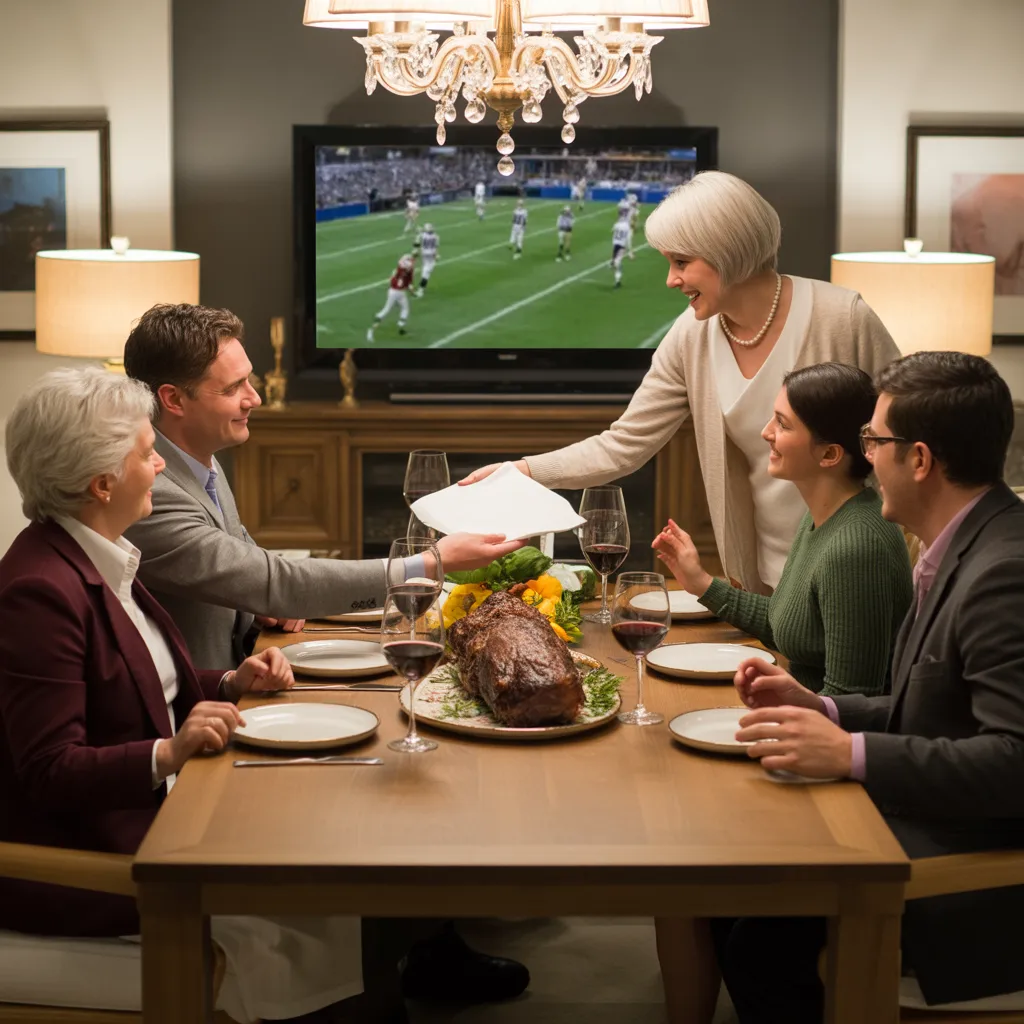
Not for one more Sunday table arranged like a stage set for my own diminishment. Some women learn that lesson early. I learned it at seventy-two, under a chandelier in suburban Denver, with a white linen napkin in my hand and laughter breaking over me like weather.
Late is still in time when it saves the rest of your life. And once you stop confusing endurance with love, you can hear the room for what it really is. Not a courtroom.
Not a market. Not a place where dignity should have to audition. Just a table.
Which means, finally, you are free to decide whether you will sit down.
ADVERTISEMENT
