ADVERTISEMENT
Attorney Watson then turned to the matter of the ownership document. “Miss Thompson, you have maintained that a signed transfer agreement legitimizes your claim to the property.
He brought up an image on his tablet, a magnified scan of the paper’s surface, showing a pattern of microscopic yellow dots invisible to the naked eye.
“This is a printer identification code. Many color laser printers embed dots that record the device serial number and the date of printing. After analyzing this document, we determined it was printed six months ago.”
Ashley’s expression collapsed.
“Six months ago,” I continued, “Grandma told you she might be returning home soon.
When you heard she might come back and check the records, you rushed to fabricate documentation.”
So Ashley forged my signature and backdated the document.
Ashley turned to our father. “You’re the one who said as long as we backdated it, it would be fine.
You told me to copy her signature.
“Ashley, stop talking,” he said. “Mom agreed,” she continued, the careful family story unraveling under the pressure of consequences that had now become real.
“She laughed and said Mandy would never be able to repay her loans anyway, so we might as well put the money to good use.”
Just three frightened people hurling accusations at each other, my father blaming my mother for the redirected savings, my mother blaming Ashley for the forged document, Ashley blaming both of them for putting her in this position, the careful family story unraveling under the specific pressure of consequences that had now become real and immediate and not something any of them could manage by framing it as concern for my character.
“That’s enough,” she said.
The shouting stopped. “Mr.
Watson, the revision to my will.”
He produced the final set of documents. “This revokes the inheritance rights of George Hansen, Sandra Hansen, and Ashley Thompson, and designates Miss Mandy Hansen as the sole heir to the entirety of the estate.”
My father reached for the table edge as if he needed it to stand.
“Mom, please.
We’re sorry. We’ve reflected. Please reconsider.”
My grandmother replied without raising her voice.
“If you want to apologize, do it to Mandy.
She is the victim. Not me.”
Every face at the table turned toward me.
I recognized what was in their expressions. The calculation that had always been there, dressed in different clothing at different times, but always the same at its center.
We’re family.
She’ll forgive us. I picked up my wine glass and took a sip. Then I set it down carefully and told them the number.
Two million dollars.
Three years of property stolen, redirected savings, forged documents, and destroyed credit. Due by morning, or formal proceedings would begin immediately.
The knock at the door came, as arranged. Two officers entered.
Ashley was escorted out still protesting, still looking for someone to blame other than herself.
My parents followed, my mother weeping in the particular way of someone who has confused the consequences of her own actions with the cruelty of the world. When the sirens faded, only my grandmother, Mr. Watson, and I remained.
I sat back down at the table among the untouched dishes and let out a long breath.
Not exhaustion. Relief, like a pressure finally released.
“It’s over, Grandma.”
“Yes,” she said. Then she paused and shook her head slightly.
“No.
This is where it begins. Your real life.”
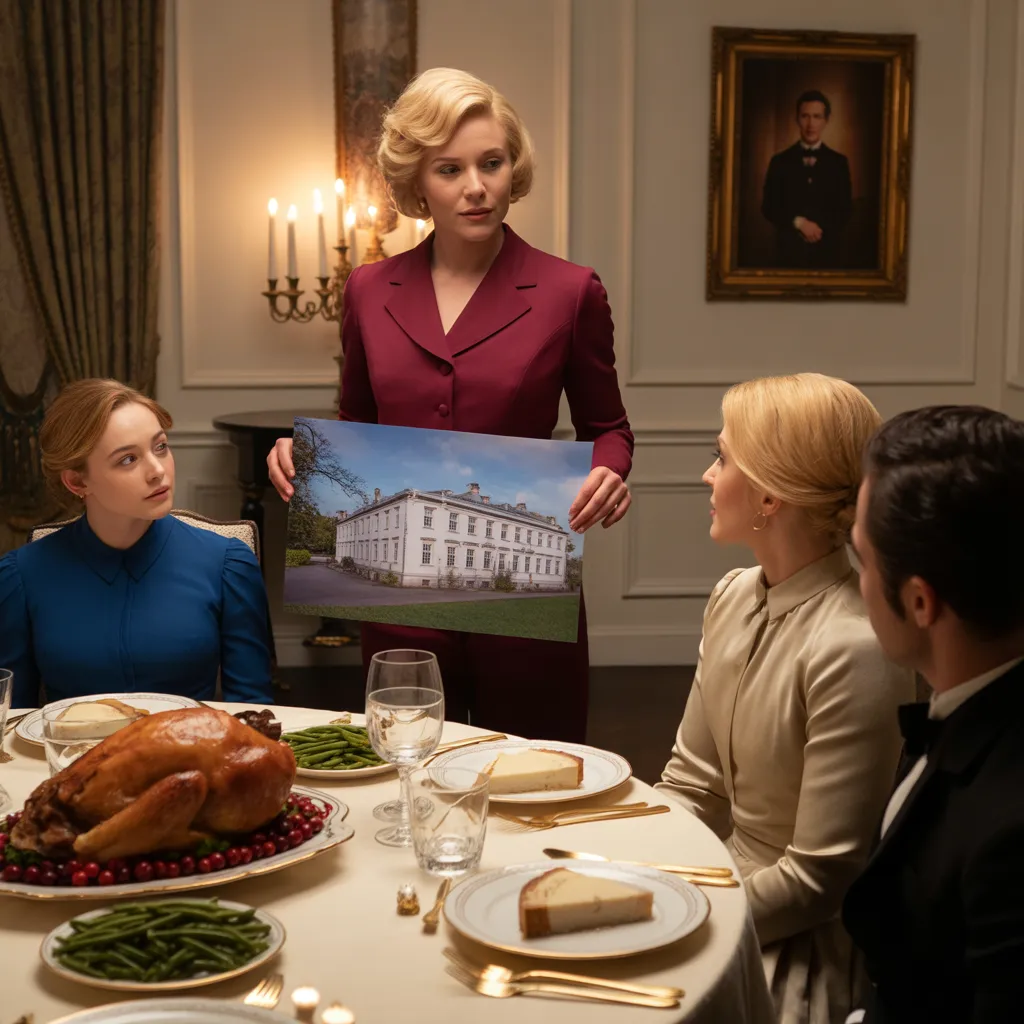
One year passed. I am writing this from the wooden deck of Lakeside Manor, which is fully and legally mine.
The view across the water is exactly what my grandmother imagined when she purchased it, wide and quiet and uninterrupted by anything except the occasional boat and the shifting quality of the light.
I have come to understand why she chose this particular place. Ashley’s in-laws vacated within seventy-two hours of Thanksgiving.
They insisted they had been told the house was legitimately Ashley’s and that they were victims of her deception as well. There was some truth in that, but they had also paid a suspiciously low rent and signed a contract with obvious gaps and never asked hard questions because the arrangement was convenient.
They were questioned and eventually cleared of charges, but the investigation was uncomfortable enough that they relocated to another state entirely.
Ashley was sentenced and divorced within the same year. The marriage dissolved when Kevin understood that the house had never been his wife’s to offer, that the comfort his parents had been living in had been paid for with someone else’s stolen future. The legal fees and the damages consumed everything she had built.
She is serving her sentence now, and I have not spoken to her since Thanksgiving.
My parents lost the social standing they had spent years cultivating and the income that had partially depended on redirecting mine. My father’s business, which had been operating under a particular kind of confidence that turned out to rest on access to resources that were not his, collapsed when that access ended.
I hear they are managing in a smaller apartment somewhere. I do not know the address and I do not look for it.
There is a difference between cutting someone off with hostility and simply declining to maintain a relationship that was never built on honesty, and I try to stay on the right side of that line without performing either bitterness or forgiveness I do not feel.
What I did instead of any of that was build something. I started an online consulting practice from this house, focused on financial recovery and legal navigation for people who had been defrauded by family members. It was not an accidental specialty.
When I began sharing the outline of my own experience, the response was immediate and larger than I had anticipated.
There were more people than I had imagined who had found themselves in the same kind of constructed trap, made to feel like their own failure what was actually a deliberate theft of their resources and their options. The schedule filled.
The income grew steadily. Within a year I had more stability than I had ever experienced during the three-job years, which had been years of genuine effort and genuine poverty at the same time, both things true simultaneously because the poverty was engineered.
I was doing plenty.
It was simply being taken. On weekends, my grandmother comes to stay. We sit by the fireplace in the evenings and talk the way people talk when they have recovered something they thought was lost, not with drama but with the quiet particular pleasure of ordinary company.
Gradually the years that were stolen begin to feel less like a wound and more like a period that has ended, which is perhaps the most useful thing time can do for a person.
One evening she looked out over the lake and said, “You didn’t just reclaim what was taken. You built something better from the same material.”
I thought about that.
About my parents teaching me that hardship builds character, the phrase they used to explain why I should be grateful for my poverty and my overloaded schedule and my twelve-dollar bank balance while they lived comfortably on the redirected proceeds of the house they had given away on my behalf. They were right that hardship can build something.
They were wrong about who was doing the building.
“This is my home,” I said, watching the light on the water. “The place I protect. The place I love.”
I turned to her and smiled in a way that did not require any performance.
“I’m happy, Grandma.”
She reached over and took my hand, and we sat there in the quiet, watching the lake hold the last of the evening light until it was gone.
ADVERTISEMENT
