ADVERTISEMENT
But as the elevator doors closed, I saw a man in a dark cap watching from the lobby below. I knew his face from Sloan’s paper. Drill Sergeant Vale had arrived early.

Part 4: The Salute That Exposed Me
Dad came alive there.
He shook hands. Nodded at uniforms. Dropped old command names. Men saw his ribbons and straightened.
Vale stood near the reviewing platform, campaign hat tucked under one arm. His eyes moved over the crowd, passed me, then returned.
Only for a second.
A warning. An acknowledgment. Or maybe just two people pretending not to know something.
Mom folded and unfolded the program.
“I’m just emotional.”
“You haven’t slept.”
“How did you know?”
“You keep spinning your ring. And you haven’t touched your tea.”
“You always notice things.”
I didn’t notice when you stopped waiting for me.
The band began. Commands rang out. Boots struck pavement in unison.
My body remembered before I gave it permission.
Shoulders square. Chin level. Hands relaxed.
Across the field, Vale’s head turned.
I forced myself to soften into an ordinary chair.
Then a radio clicked twice behind the bleachers.
No civilian would notice.
Vale noticed.
So did I.
A white maintenance van sat near the service road. A man in a dark polo stood beside it, speaking into a radio. Wrong shoes. Too clean for maintenance. Too calm for a lost staffer.
Then a little boy ran after a dropped cap, chasing it under the rope barrier near the service path.
The man saw him.
His hand moved.
I stood.
Dad snapped, “Evelyn, sit down.”
I stepped into the aisle.
“Hey, buddy,” I called lightly. “That yours?”
I reached the cap before the boy crossed fully into danger. I handed it back with a smile.
“Dinosaurs are serious business.”
He grinned. “It’s a T. rex.”
“Best one.”
Behind him, the man in the dark polo changed direction.
Vale was already moving.
The loudspeaker screamed with feedback. The superintendent’s voice cut out. People flinched.
Then a command rang from the platform.
“Attention!”
Hundreds of bodies snapped still.
Mine did too.
Not like a spectator. Not like someone copying.
Like a soldier.
My heels aligned. Shoulders set. Eyes forward. The pen hidden in my hand remained invisible.
Dad’s mouth opened.
Caleb, in formation across the field, saw me too.
But Vale saw more than posture.
He saw my hand position. My eyes. The threat near the van.
Then he stopped in front of my row.
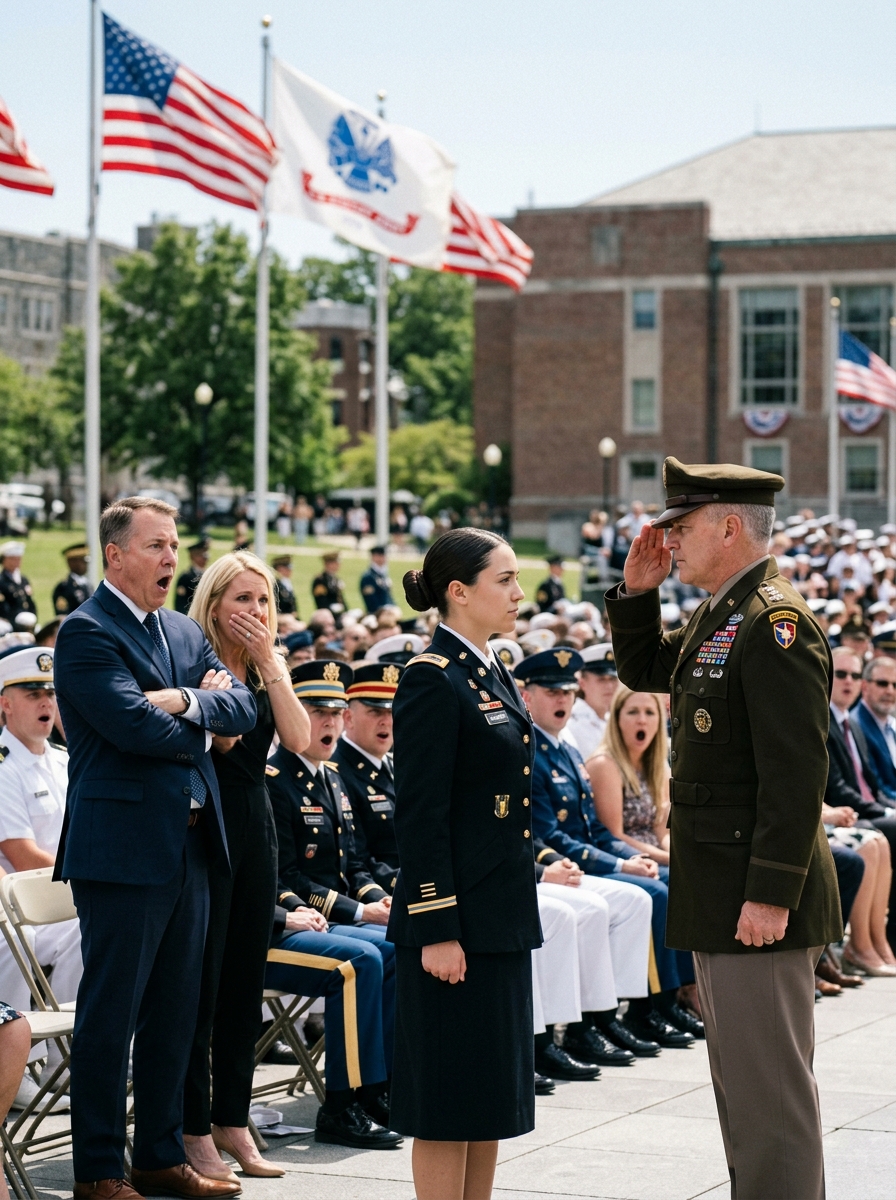
In front of everyone, Drill Sergeant Marcus Vale snapped to attention and saluted me.
For one second, the world went silent.
My father turned so quickly his medals clicked.
Mom whispered my name.
Caleb’s eyes widened.
I returned the salute.
I had not planned to. Sloan would have hated it. But refusing acknowledgment would have become its own kind of lie.
“Ma’am,” Vale said quietly.
That word detonated more effectively than any shout.
Dad actually stepped back.
I kept my voice low.
“Sergeant Vale.”
His eyes flicked toward the van.
“We have an issue.”
“I noticed.”
Dad found his voice.
“What the hell is going on?”
No one answered him.
That may have been the first time in his adult life a room did not rearrange itself around his demand.
Part 5: The Threat at the Ceremony
Vale spoke quickly.
“Local communications are failing. One unknown near service access. Possible device. Possible extraction. We can’t clear the cadet line without panic.”
“How many?”
“Confirmed one. Suspected two.”
“Where’s the second?”
He did not answer.
Because he did not know.
A fresh wave of feedback hit the speakers. The man near the van used the distraction to move.
I turned to Mom.
“Stay seated. Hands visible. If people move, you do not move until uniformed security tells you.”
Dad’s face darkened.
“Don’t you give orders to your mother.”
I looked at him.
Not angrily. Anger wasted time.
“Sit down, Victor.”
His name hit harder than a rank.
For once, he sat.
I moved toward the service road. Walking, not running. Running spreads fear. Purpose creates space.
The man in the dark polo saw me coming. His eyes shifted toward Caleb’s row.
That was the first emotional crack.
Whatever Caleb had been, he was still my brother.
I stepped closer.
“Sir,” I called brightly, “you dropped your credential.”
He hesitated and looked down.
That half second was enough.
I stepped inside his reach and drove the hidden point of the pen into the nerve cluster above his wrist. His hand opened. A small black transmitter hit the ground.
I pinned him against the van as security arrived.
Then someone shouted from the sound booth.
“Second suspect!”
A maintenance worker on the platform stairs froze with one hand inside an equipment case. He was near the microphone cables, the superintendent, and the cadet flag bearers.
Close enough that one wrong move could turn confusion into panic.
I walked toward him with my hands partly raised.
“Wrong case?” I asked lightly.
He dismissed me as a nervous civilian.
Useful mistake.
I stumbled just enough for his eyes to drop.
Then my hand snapped out.
The pen struck the back of his hand, forcing his fingers out of the case. Vale moved. So did I. The man lunged toward the microphone, but I caught his jacket, turned his momentum, and drove him down onto the platform.
The equipment case tipped open.
Inside was not a bomb.
It was a signal repeater, modified to use the ceremony’s audio system to push a burst transmission through nearby receivers—phones, radios, cadet devices, security channels.
Not meant to kill bodies.
Meant to harvest identities, locations, and access.
“Shut it down!” Vale barked.
“I need ten seconds.”
“You have five.”
I dropped beside the case. Wires nested inside like veins. My hand found the dull gray feed hidden beneath black tape.
I cut it with the edge concealed in the pen cap.
The repeater died with a soft click.
No explosion.
No spark.
Just the quiet of disaster missing by inches.
Vale crouched beside me, blocking cameras with his body.
“You good?”
“Fine.”
“Your hand’s bleeding.”
I looked down. A wire had cut my palm.
The microphone was still live when Vale spoke again.
“Medic for the major.”
The title rolled across the speakers before anyone could stop it.
Major.
It hit the bleachers. The cadets. The front row.
My father stood frozen, his service jacket suddenly looking like it belonged to another life.
Caleb’s formation finally broke when the emergency command cleared the field.
He turned toward me, face stripped bare.
Not admiration.
Not yet.
Fear.
Because he had just watched his useless sister stop two men in front of everyone.
And the drill sergeant had called her Major.
Part 6: The Apology That Came Too Late
They moved us into a side building that smelled of floor wax and overworked air conditioning.
Federal agents questioned me. I gave the authorized version, which was not a lie so much as a hallway with most doors locked.
My family waited behind the glass wall.
That was the strangest part.
Not the suspects. Not the salute. Not the title.
Watching my father watch me.
He stood rigid, face gray, ribbons perfect. Mom cried into a tissue. Caleb looked like he had forgotten how to stand inside his own skin.
Vale opened the door.
“They can come in if you approve.”
If I approve.
My father heard that.
I wanted to say no.
For seven years, they had accepted the easiest version of me because it cost them nothing. Now the truth had embarrassed them publicly, and they wanted access. Explanation. A way to reshape the story so they had not been cruel, only uninformed.
But Mom’s face was wet. Caleb looked shaken by more than pride.
“Five minutes,” I said.
They entered like strangers.
Mom reached me first.
“Evelyn, your hand.”
“It’s fine.”
“You always say that,” she whispered.
Dad stopped three feet away.
For once, he did not fill the room.
Caleb stared at the bandage.
“Are you really a major?”
“Yes.”
“Since when?”
“Long enough.”
Dad’s voice came out rough.
“Why didn’t you tell us?”
“I couldn’t.”
“That’s it?” Caleb asked. “You couldn’t?”
“There were restrictions. Still are.”
Dad looked at Vale.
“You knew?”
Vale said, “I knew enough to render appropriate respect.”
Appropriate respect.
My father flinched.
Mom sat beside me, her hand hovering near mine.
“All those years, when you were gone…”
“I was working.”
Dad swallowed.
“Doing what?”
“Things I can’t describe just to make you feel better.”
The room changed temperature.
Dad took a breath.
“Evelyn, we didn’t know.”
“No,” I said. “You didn’t.”
“We thought—”
“You chose.”
His mouth closed.
“You chose the version of me that made sense to you,” I said. “Weak. Lost. Useless. You chose it when I was a child, before there were secrets. You chose it every time you made me the punchline because asking why I was quiet would have made you uncomfortable.”
Mom cried harder.
Caleb whispered, “Evie…”
I turned to him.
“You laughed.”
His face reddened.
“I was a kid.”
“So was I.”
That silenced him.
Dad looked as if every medal on his chest had gained weight.
“I was wrong,” he said.
Once, I thought those words would heal something.
They didn’t.
They simply stood in the room, too late to become enough.
“I know,” I said.
“And I’m sorry.”
The words were stiff, but real.
The problem was, real apologies do not erase real years.
Mom reached for me.
“Can we fix this?”
I looked at her hand. The hand that had stirred coffee, folded laundry, touched Dad’s arm in warning, but never stopped him.
“I don’t know,” I said. “But not today.”
Dad’s face tightened.
“Evelyn, don’t do this now.”
There he was.
Not sorry enough to stop demanding the timing.
“I’m not doing anything,” I said. “I’m telling the truth. You don’t get to meet me for the first time today and call it a reunion.”
Caleb’s graduation resumed indoors. He came toward me before entering the auditorium.
“I’d like you there,” he said.
For once, there was no smirk.
“I’ll stand in the back,” I said.
Part 7: Forward
Caleb graduated under fluorescent lights in an auditorium that had not been built for glory.
No flags snapping in sunlight. No perfect field. No grand music echoing across open air. Just beige walls, nervous families, federal agents in corners, and cadets trying to act as if their ceremony had not nearly become something else.
When Caleb’s name was called, Dad clapped first. Loud as always, but the sound cracked halfway through.
Mom cried.
I clapped too.
Not because everything was forgiven.
Because Caleb had earned that walk, and I was not my father. I did not need to make someone else smaller to stand upright.
Afterward, Caleb came to me alone.
“I did laugh,” he said.
“Yes.”
“I knew Dad was unfair.”
“Sometimes?”
He winced. “A lot.”
Then he looked down.
“I think I liked it. Being the one he understood. If you were the disappointment, I didn’t have to be.”
That honesty mattered.
“I’m sorry, Evelyn.”
“Thank you.”
“Can we start over?”
I looked across the room at Dad, watching us with hope and fear.
“I can’t start over,” I said. “But we can start from here.”
“What does that mean?”
“No pretending. No jokes that are knives. No asking me to keep Dad comfortable. No acting like one apology fixes a childhood.”
“I can do that.”
“I hope so.”
He smiled faintly.
“You sound like a commanding officer.”
“I am one.”
Then Dad came over.
“They want family photos,” he said.
He looked at me.
“Evelyn, you should be in them.”
Should.
Not I want you there.
Not you belong there.
A correction to appearances.
“No,” I said.
Mom’s face folded.
“Honey, please.”
“I love you, Mom. But I’m not standing in a family photo today so everyone can feel better about what they learned.”
Dad flushed.
“This is still your brother’s graduation.”
“Yes,” I said. “So stop making my answer the problem.”
Caleb stepped between us slightly.
“She said no, Dad.”
Dad stared at him, shocked that his golden boy had chosen my boundary over his comfort.
Then Dad looked down.
“All right,” he said.
It was the first order of mine he had ever obeyed.
I left through the rear exit.
In the hallway, Mara Reed leaned against the wall in civilian clothes, holding two coffees.
“Heard you ruined a perfectly good ceremony,” she said.
I laughed once, and it almost became a sob.
Then Sloan stepped out of the stairwell.
Her face told me the day was not finished.
The captured suspects were already talking. The repeater traced back to a domestic network. A man named Colonel Peter Ashwell—one of Dad’s old military acquaintances—had been seen near the ceremony field.
He had eaten in our backyard once. Complimented Caleb’s “command presence” while I carried trash bags past him.
Now he was missing.
We found Dad in the courtyard holding his phone.
“Who called?” I asked.
His hand closed around it.
“Was it Ashwell?”
The blood left his face.
That was answer enough.
His phone buzzed.
Unknown caller.
For one long second, I did not know which habit would win: his pride or my voice.
Then he handed me the phone.
I answered silently.
Ashwell’s warm voice came through.
“Victor, listen carefully. Your daughter is not who you think she is.”
I looked straight at my father.
“No,” I said. “I’m exactly who he never bothered to see.”
Ashwell went quiet.
Then he laughed softly.
“Evelyn Carter,” he said. “Still organizing rooms before you burn them down.”
We caught him at a private airfield forty-six minutes later.
No dramatic gunfight. No speech beside a helicopter. Just federal vehicles boxing him in before his pilot finished preflight.
Ashwell looked at Dad.
“You know what’s tragic, Victor? She became everything you worship, and you still needed another man to salute her before you noticed.”
The words landed hard.
Dad closed his eyes.
By sunset, the network was being unwound. The academy sealed itself behind official statements. Caleb’s class had graduated. My seventy-two-hour leave had become something heavier.
Back at the hotel, Dad stood when I entered.
“I don’t know how to be your father right now,” he said.
It was the most honest thing he had ever given me.
“I know.”
“I want to fix it.”
“You can’t.”
“I’m sorry. For today. For before today. For all of it.”
I let the apology stand.
“I believe you’re sorry,” I said.
His eyes lifted with hope.
“But I don’t forgive you.”
Mom made a small sound.
“I spent my life making myself smaller so this family could stay comfortable,” I said. “Then I spent seven years silent because other people’s lives depended on it. I won’t spend the rest of mine pretending pain disappears because you finally recognized it.”
Caleb wiped his face.
“What about me?”
“You get a chance,” I said. “Not because you’re owed one. Because today, you told the truth without asking me to comfort you.”
He nodded.
“I’ll take that.”
Outside, a black SUV waited under the awning. Mara leaned against it, arms crossed.
Dad asked, “When will we see you again?”
“When I choose.”
He flinched.
Then accepted it.
At the door, Caleb called my name.
“Evelyn.”
I turned.
He stood straight and raised his hand in a salute. It was not perfect. His wrist bent slightly.
But his face was sincere.
I returned it.
Dad watched with wet eyes and hands at his sides. He did not salute.
I was glad.
From him, it would have been too easy.
I walked out into the evening.
Mara opened the passenger door.
“You okay?” she asked.
I looked back through the glass. My father stood beneath yellow lobby lights, smaller than the man who had ruled my childhood. My mother sat with clasped hands. Caleb watched me leave like he finally understood that seeing me clearly did not mean keeping me.
“No,” I said. “But I’m free.”
Mara smiled.
“That’s a start.”
As we pulled away, my phone buzzed with a message from Sloan.
New assignment pending. Rest first.
For the first time in years, I did not read between the lines for danger.
I rolled down the window and let the damp night air touch my face.
They had called me useless because they could not measure quiet strength.
They had called me weak because I refused to perform power for people who confused volume with courage.
They had called me lost because I walked a road they were not allowed to see.
But now I knew exactly where I was going.
Not back.
Forward.
THE END!
ADVERTISEMENT
