ADVERTISEMENT
Calloway,” he said at the door, and there was something respectful in it that had not been there when he arrived. “Thank you for the coffee.”
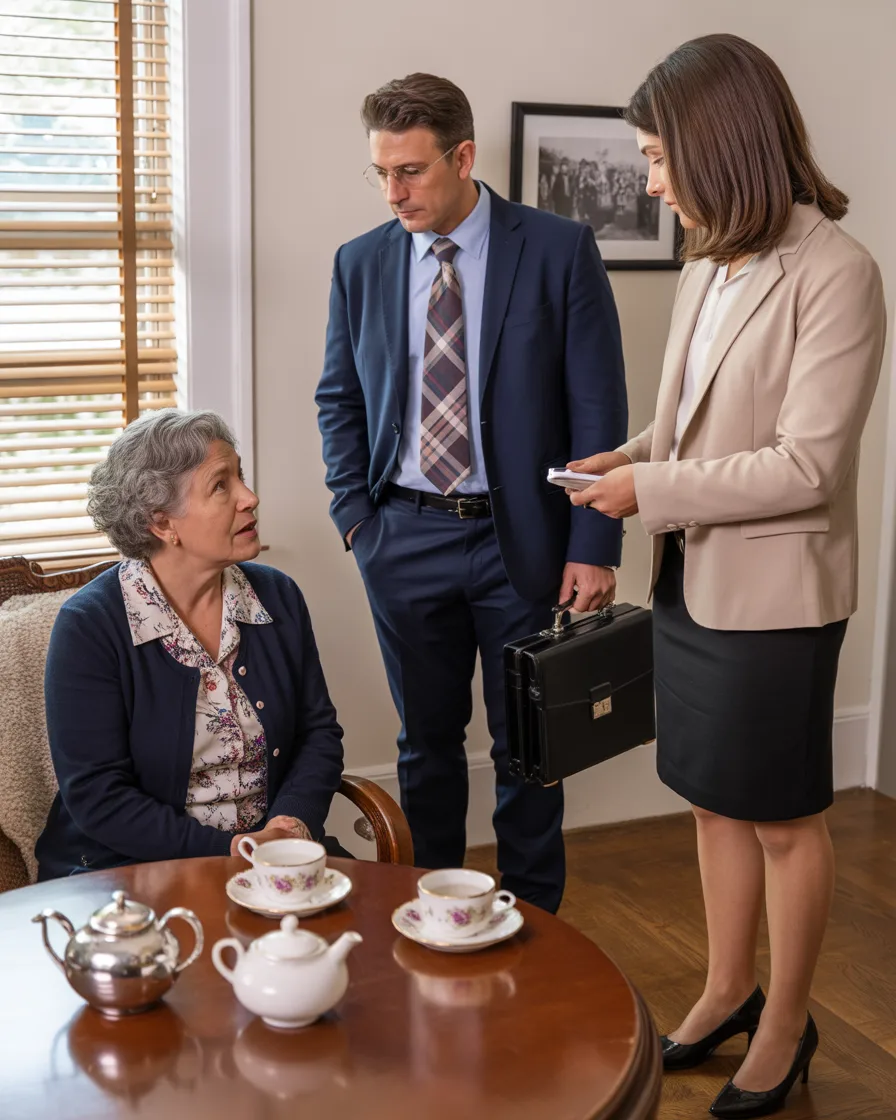
For a moment the look on her face was complicated in a way I had not seen from her before, no performance in it, no calculation. She looked at me with something close to real curiosity, like a woman who has spent her life thinking she understands the room and has discovered that one room was different from everything she expected. Then she left.
I stood in my doorway and watched the car back out of the drive and disappear down the street, and the November light came gray and quiet across the garden Harold had planted the summer before he retired, and I stood there until the sound of the engine was gone. Then I went inside, refilled my coffee, and sat back down with my book. Matthew called at six-thirty.
I let him finish.
I always let him finish. It was a habit I had developed when he was a teenager and had strong feelings about things and needed to exhaust them before he could hear anything else. “Your wife came to my home today with a notary,” I said, when he was done.
The silence that followed lasted long enough to tell me what I needed to know. “I didn’t know,” he said finally. “I believe you,” I replied.
But I was not angry at Matthew. I was sad about him, in the way you are sad about a person who is not quite strong enough to be who they might have been. “Why didn’t you ever tell me?” he asked.
The photographs on the mantel: Harold and me on our twenty-fifth anniversary, Matthew at his college graduation, the faded print from a trip to the Oregon coast we took the summer before Harold’s health began to turn. The reading chair that had been his. The lamp beside it that I had never moved.
“Because I wanted to know,” I said, “who loved me for me. Not for what I had.”
“Come for lunch,” I said. “I’ll make something.”
He came. He sat at my kitchen table in the same chair he had sat in as a boy, and he looked like someone who had not slept well, which was probably true.
Some of it was quite hard, particularly the part where he told me that he had known Brooke was planning to talk to me about the house, that he had not asked questions he should have asked, that it had been easier to let her handle things than to think about what handling them meant. I listened to all of it without interrupting, which was something he seemed to be bracing against and then didn’t need to brace against, which I think surprised him. “She thought I had nothing,” I said, at some point.
Matthew looked at his hands. “She’s not wrong that I should have told you more,” I said. “Your father and I made a choice not to structure things around the inheritance.
We wanted what we built together to be what held us together. I think we were right. But it meant you went into your marriage without the full picture, and she filled in that picture with her own assumptions.”
“And I let her,” he said.
“Yes.”
He asked me what happened now. I told him the truth: that nothing changed immediately. That the trust would govern things as it had always governed them.
That when the time came, the ranch and whatever remained would pass to him as Harold and I had planned, with certain conditions attached that Gregory Walsh had been very thoughtful about and that I would share with him when it felt right. “And Brooke?” he asked. “That,” I said, “is a question only you can answer.”
I did not tell him what I thought.
A mother has opinions about her son’s marriage, and the wise ones know when to keep those opinions in the same fireproof box where they keep the important documents. I passed him more bread and we finished the soup and he helped me clear the table before he left, which he had not done in a long time. He called her from my driveway before he drove home.
I did not listen, but I could see him through the kitchen window, sitting in his car in the gray afternoon, talking for a long time. What came of that conversation, and of the weeks that followed, I will keep mostly to myself. Marriages are complicated, and the damage done to one is not always irreparable, and the people in them are the ones who have to decide what to do with the damage.
Matthew and Brooke are still married. Things between us are different now, cautious in some ways and more honest in others, which may be an improvement even if it does not feel like one. What I can tell you is that Brooke has not been back to my house uninvited since that Tuesday, and that when she does come, she sits in the living room and accepts the coffee I offer in the real china cups, and does not look around the room in that particular calculating way.
Whether this represents genuine change or merely adjustment, I cannot say. I have lived long enough to know the difference between the two is sometimes smaller than we want it to be. The ranch is still there.
I visited it last summer, the first time since Harold died that I had made the drive alone. I had asked Gregory whether he thought it was time, and he had said in his quiet, considered way that it was entirely up to me, which I knew was his manner of saying yes. The neighboring family who leases the cattle operation met me at the main house with their youngest daughter, who is eleven and fierce and reminds me powerfully of Harold in the way she moves through the land as if she belongs to it and has always belonged to it and cannot quite imagine why anyone would need to be told this.
We walked the fence line in the late afternoon, the three of us, and the girl told me about the changes in the herd since last year with the absorbed authority of someone for whom these things are simply facts of the world, not details requiring effort to retain. Her mother walked beside me and we talked about the lease terms coming up for renewal and about the drought two summers back and about the way the water table had been behaving, and it was a good conversation, the kind where both parties are paying attention and neither is performing. I watched the light change across the high desert the way it does in early August, going from gold to copper to something almost red at the edges, and I stood at the fence line Harold had helped his father mend the summer he was sixteen and thought about the fireproof box and about what Harold had meant when he said not because we have secrets but because we have things worth protecting.
He had meant the documents, of course. The deed and the trust and the papers that took years to get exactly right. But he had also meant something harder to hold in a folder.
He had meant the life inside the house, the photographs on the mantel, the reading chair by the window, the coffee he complained about every morning for forty years. He had meant me. I drove back to Seattle through the mountain pass with the windows down, and the air smelled of pine and something drier and older underneath it, the smell of the high desert that clings to your hair and your clothes for hours after you leave.
I did not feel like a widow managing an estate or an old woman who had been lucky to have good lawyers. I felt like a woman who had been trusted with something and had proved herself equal to that trust when the moment arrived. The sky over the Cascades was still light at eight in the evening, that long northwestern summer light that seems reluctant to let the day end.
I drove through it with the radio off, thinking about Harold’s fence post and the eleven-year-old girl who knew the herd changes by heart and the way the last light had gone across the land before I left. I thought about the fireproof box on the closet shelf and the afternoon Brooke and Paul sat in my living room expecting a routine signature. Some people see an older woman in a quiet house and assume she has become part of the furniture.
I have always found it useful to let them think that. Not because I enjoy the deception, but because what a person assumes when they stop paying attention tells you everything you need to know about what they were actually after. That is not nothing.
That is, in fact, everything that Harold intended.
ADVERTISEMENT
