ADVERTISEMENT
Not in relief. Not yet. Because relief would mean this had not happened.
He was looking at me. Really looking for the first time since I had walked into that room. “I…”
He started, but the word did not go anywhere.
Just like that?”
“I’m saying,” Daniel replied, “that the second test followed verified protocol from start to finish. The chain of custody is intact, the samples were cross-checked, and the results are conclusive.”
“Should not have been released in the condition it was,” Daniel said firmly.
His words were precise, professional, but they carried enough weight to tip the balance. Diane opened her mouth, then closed it again. For the first time since I had known her, she did not have an immediate response.
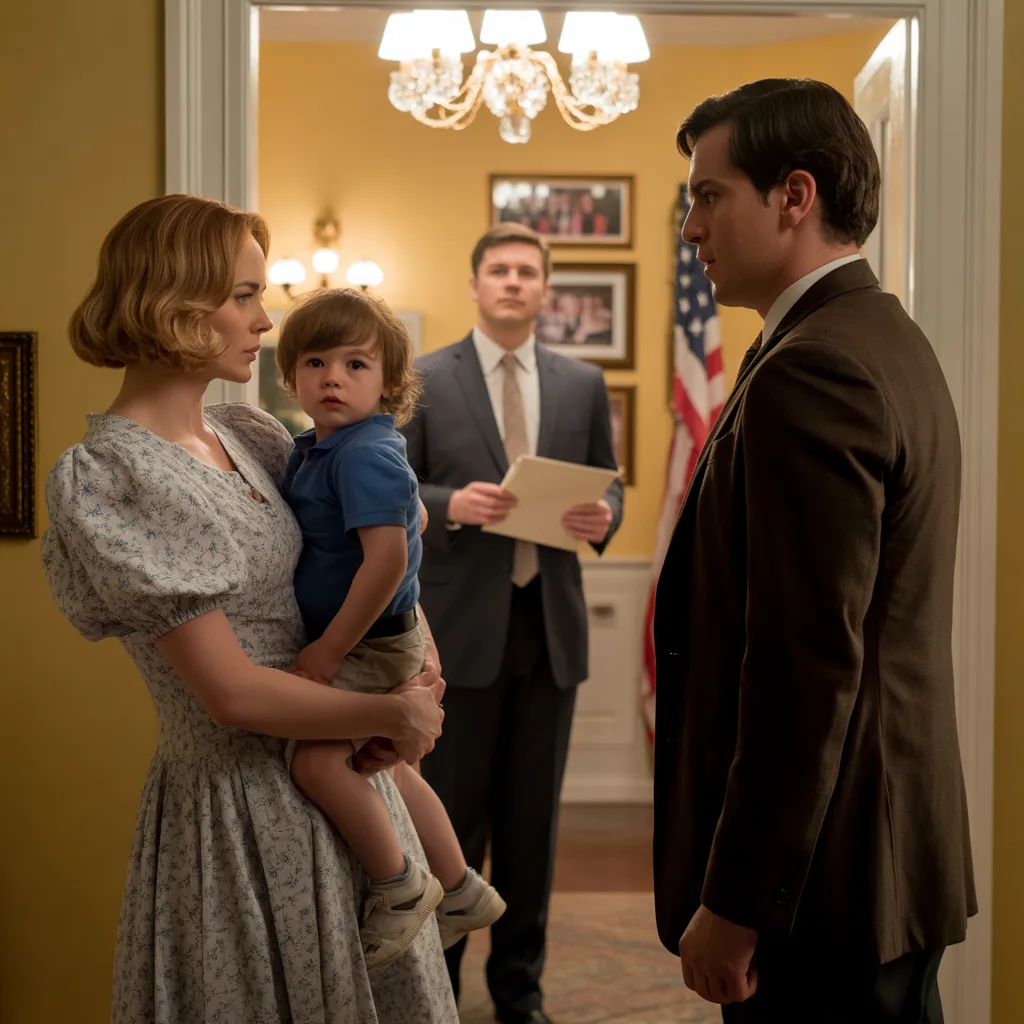
I pressed my lips together, steadying myself. “This is my son,” I said quietly. No one argued.
No one whispered. And yet the silence did not feel like victory. It felt like aftermath.
It did not come with relief or even immediate apology. It just sat there, heavy and undeniable, like a mirror no one wanted to look into. Daniel Reeves gathered his documents with quiet efficiency.
“I’ll leave copies of the corrected report,” he said, placing them on the coffee table. “If you have further questions, the lab will cooperate fully.”
Daniel gave a small, respectful nod to me more than anyone else, then turned and walked out.
The same people. But everything had shifted. I looked around slowly, taking in the faces that minutes ago had been so certain.
Karen’s arms were no longer crossed. They hung awkwardly at her sides. My husband’s uncle stared at the floor like it might offer him an escape.
Even Diane, so composed, so commanding, looked unsettled. But none of that erased what had happened. My husband picked up the new report, scanning it like he needed to read it ten times to believe it.
“Ninety-nine point nine-nine,” he murmured. I did not move closer. I did not reach for him.
Because the distance between us was not physical anymore. It was something deeper. “You should say something,” Karen muttered under her breath, glancing at him.
He looked up. At me. “I’m sorry,” he said.
Two words. Simple. But they did not land the way he probably hoped they would.
“Are you?” I asked quietly. He flinched. Not dramatically, just enough to show it hit.
“Because you didn’t just question me,” I continued. “You investigated me. You tested me behind my back.”
“And then you brought me here.”
I gestured to the room.
“So your entire family could watch me be torn apart.”
“No one tore you apart,” Diane snapped reflexively. I turned to her. “No,” I said.
“You told me to get out of your house. You pointed at me like I was something dirty you needed to remove.”
Her lips pressed together, but she did not respond. “That wasn’t concern,” I added.
“That was judgment.”
Silence again. My husband stepped closer, his voice lower now. “I didn’t know it would turn into this.”
“You didn’t stop it either,” I said.
That one landed. He exhaled slowly, running a hand over his face. “I thought… I thought I needed answers.”
“And you decided I wasn’t worth asking,” I replied.
There it was. The core of it. Not the test.
Not even the accusation. The choice. He did not answer because there was not a good one.
From across the room, Diane straightened slightly, regaining some of her composure. “If there was confusion,” she said carefully, “it’s because the situation raised reasonable concerns.”
I let out a quiet breath. Not quite a laugh, but close.
“Reasonable?” I repeated. She nodded, holding on to that word like it could still defend her. “Your son doubted me,” I said.
“And instead of questioning that doubt, you supported it.”
“I protected my family,” she said. “And I’m not your family?” I asked. That stopped her.
For a second, something flickered across her face. Something less certain, less controlled. But it passed.
“You are,” she said. “But situations like this—”
“No,” I interrupted gently. “Situations like this show exactly who counts.”
That one did not need to be loud.
It carried anyway. Karen shifted again. “Look, no one expected the test to be wrong,” she said softer now.
“We reacted to what we were given.”
“And I reacted to being accused of something I didn’t do,” I replied. “In a room full of people who didn’t give me the benefit of a single doubt.”
No one argued. Because they could not.
Ethan stirred in my arms again, letting out a small sleepy sound. I adjusted him instinctively, pressing a soft kiss to his hair. That small, ordinary gesture grounded me.
Reminded me what actually mattered. “I think you should stay,” my husband said suddenly. “We can talk.
Figure this out.”
I looked at him. Really looked at the man I had built a life with. At the man who had stood in silence while I was dismantled.
“I will talk,” I said. “But not here.”
His brow furrowed. “What do you mean?”
“I mean this isn’t something we fix in front of an audience,” I said.
“This isn’t a misunderstanding we laugh off over dinner.”
Diane inhaled sharply, but I did not look at her. “This is about trust,” I continued. “And right now, that’s not something I feel.”
My husband swallowed.
“So what are you saying?”
I shifted Ethan again, steadying myself before answering. “I’m saying I’m going home,” I said, “with my son.”
“And then?” he asked. “And then you decide,” I replied, meeting his eyes, “whether you want to rebuild something or just pretend this didn’t break it.”
He did not speak.
He did not argue. Because for the first time that night, he understood the position he was actually in. Not the victim.
Not the judge. The one who had something to prove. I turned toward the door.
This time, no one stopped me. No one told me to leave. No one told me to stay.
And somehow that silence felt more honest than anything that had come before it. As I stepped outside, the evening air felt different. Cooler.
Clearer. Behind me, the house stood exactly as it always had. But I knew something had shifted.
Not just in them. In me. Because walking away this time was not defeat.
It was choice. I did not sleep much that night. Ethan did, curled up beside me, one small hand resting against my arm like an anchor.
Every time I shifted, he adjusted without waking, trusting that I was still there. That word stayed with me. Trust.
Not the kind people say out loud. Not promises or reassurances. The quiet kind.
The kind you do not question until someone gives you a reason to. By morning, the house felt different. Not broken.
Not empty. Just honest. I made coffee, fed Ethan, and let the rhythm of small, ordinary things steady me.
Around nine, there was a knock at the door. I did not rush to answer it. I already knew who it was.
When I opened it, my husband stood there alone. No mother. No sister.
No audience. Just him. He looked tired.
Not from lack of sleep, but from something heavier. The kind of exhaustion that comes from realizing you were wrong in a way that cannot be undone. “Can I come in?” he asked.
I hesitated for a second, then stepped aside. He walked in slowly, like he was not sure he deserved to be there. His eyes moved around the room, taking in the familiar things.
The couch. The toys. The life we had built.
Ethan looked up from the floor and broke into a smile. “Dada.”
That sound hit both of us. My husband froze for a fraction of a second, then crouched down, instinct taking over.
Ethan toddled into his arms without hesitation, wrapping his little arms around his neck. No doubt. No distance.
Just love. I watched them quietly. This is what you almost lost, I thought.
Not just me. All of it. After a moment, he stood again, still holding Ethan like he was not ready to let go.
“I don’t deserve how easy that was,” he said softly. “No,” I replied. “You don’t.”
He nodded.
“I know saying I’m sorry isn’t enough,” he continued. “But I am. Not just for the test.
For everything that came after it.”
I leaned against the counter, arms loosely folded. Not closed off, but not open either. “You didn’t trust me,” I said.
“I doubted you,” he corrected quietly. “And instead of coming to you, I went looking for proof to justify that doubt.”
“That’s worse,” I said. “I know.”
There was no defensiveness in his voice now.
No excuses. Just recognition. “I let my fear turn into suspicion,” he continued.
“And I let my family’s voices get louder than yours.”
That part mattered because it was true. “I stood there,” he added, his voice tightening slightly, “and I watched them treat you like… like you didn’t belong.”
“And I didn’t stop it.”
“No,” I said softly. “You didn’t.”
Ethan shifted in his arms, playing with the collar of his shirt, completely unaware of the weight of the moment.
My husband looked down at him. “I don’t want to be that man,” he said. “The one who chooses doubt over the person he promised to trust.”
I studied him carefully because apologies are easy when the truth is already proven.
What matters is what comes after. “Your mother,” I said after a moment. He exhaled slowly.
“She was wrong.”
“That’s not something she says easily.”
“I know. And yet she said it this morning,” he added. “Not well, not perfectly.
But she knows she crossed a line.”
I considered that. Diane apologizing, even imperfectly, meant something. Not everything.
But something. “And you?” I asked. He met my eyes.
“I’m not asking you to forget,” he said. “I’m asking for the chance to rebuild.”
There it was. Not a demand.
Not an expectation. A request. I looked at Ethan again, at the easy way he leaned into his father, the unquestioned connection between them.
And I thought about what kind of home I wanted him to grow up in. One built on silence and resentment, or one where mistakes were acknowledged and changed. “I’m not going to pretend this didn’t happen,” I said finally.
“I wouldn’t ask you to.”
“And I’m not going to trust you the same way right away.”
He nodded. “I understand.”
“But I will give you the chance to earn it back.”
Something in his expression shifted. Not relief exactly.
But something close. “Thank you,” he said. “This isn’t forgiveness,” I added gently.
“It’s a beginning.”
“That’s enough,” he replied. Later that week, we sat down with Diane. It was not dramatic.
No raised voices. No long speeches. Just a conversation.
Uncomfortable. Honest. She did not cry.
She did not soften completely. But she looked at me and said, “I was wrong to judge before I understood.”
And for her, that was a lot. It did not erase the moment.
But it acknowledged it. And sometimes that is where healing starts. Weeks passed.
Then months. Trust did not come back all at once. It came in small ways.
In conversations that did not get avoided. In questions that got asked instead of assumed. In the quiet daily choice to believe each other again and again.
And one evening, sitting at the same table that once felt like a courtroom, I realized something. Family is not just about who stands with you when things are easy. It is about who learns how to stand with you when they were wrong.
If you have ever been misunderstood, judged too quickly, or hurt by the people who were supposed to protect you, know this. Truth has a way of finding its way back. But trust — trust is something we build carefully, patiently, and never blindly.
If this story resonated with you, take a moment to reflect on the people in your life and the trust you share with them. And if you believe in stories that remind us what really matters, consider sharing this one or staying with us for more.
ADVERTISEMENT
