ADVERTISEMENT
“I am facing you.
“We don’t have money for a motel! We spent everything on Bella.”
“Then go stay with Bella.
“She’s paying for that herself,” he shouted. I did not answer that, because I already suspected it was a lie and I was still working out the shape of it.
I released the button and went to my laptop. The county property records database for Ohio is public information. I searched my parents’ old address.
Six hundred and twenty thousand dollars. They had bought that house in the nineties for perhaps a hundred and fifty. It had been paid off for years.
Enormous, yes. Catastrophic, yes. But six hundred and twenty thousand minus two hundred thousand left four hundred and twenty thousand dollars.
A story posted four hours earlier showed her holding a glass of champagne in what was unmistakably a resort room. Location: Grand View Resort and Spa. Caption: New beginnings.
Manifesting abundance. Hashtags that included the phrase crypto queen. I scrolled back two days.
The nausea arrived before the arithmetic finished. They had not just paid her debt. They had given her everything.
The debt cleared, a Porsche purchased, and the remaining cash poured into whatever cryptocurrency scheme Bella was currently presenting to them as a guaranteed return on investment. They were broke not because they were generous but because they were all in, because they had bet the farm literally on Bella becoming wealthy and had blown the remainder on her image maintenance. Their backup plan, their safety net, their retirement accommodation, was my house.
The pity I had been holding since they arrived evaporated. Around nine-thirty, a piece of notebook paper slid under the front door. I picked it up.
Bella would have the upstairs guest room with the lake view, for her content creation, which required natural light. I would relocate to the loft office or, if I preferred more space, the unfinished basement. Total rent: three hundred dollars monthly.
I would continue to pay all utilities, internet, and property taxes, as these were my asset. Meals would be communal, with me cooking dinner five nights a week as my contribution to the household. I would not have overnight guests without my mother’s prior approval.
I read it twice. My hands were shaking. They did not want to move into my house.
They wanted to evict me from it. They wanted to place me in the unfinished basement of a building I had constructed with my own hands while they occupied the best rooms, on the understanding that I would also cook and clean and seek permission to have friends over, for three hundred dollars a month in a house where the mortgage alone was twenty-four hundred. I found a Sharpie in the kitchen drawer.
I wrote NO across the entire page in letters large enough to read without glasses. I unlocked the front door, kept the security chain engaged, and shoved the paper back through the gap. My father snatched it.
He read it. The shouting resumed. I closed and bolted the door again and went to sit on the floor of my bedroom with my back against the wall.
I heard a new engine in the driveway. Not the U-Haul. A van.
The camera showed a white vehicle with Lakeside Lock and Key printed on the side. My father was talking to a man in coveralls, pointing at my front door, showing his driver’s license. He had called a locksmith.
He was going to drill the locks. I ran to the living room window and threw up the sash. “Don’t touch that door,” I shouted down at the locksmith.
“I am the owner. That man is trespassing. If you drill that lock I will sue you and call the police for breaking and entering.”
The locksmith, a bearded man holding a drill, looked from me to my father.
My father insisted I was mentally unstable, that this was his vacation property, that his son was squatting inside. The locksmith looked at my father’s Ohio driver’s license, then back up at me. “Sir, your ID says you live in Ohio.”
“We just moved,” my father insisted.
“This is my vacation home.”
The locksmith shook his head and put the drill back in his bag. “I can’t get involved in a domestic dispute. If you don’t have proof of ownership and someone inside is claiming trespass, I’m out.” He retreated to his van and reversed down the driveway at a pace that communicated clearly how eager he was to be elsewhere.
My father stood in the rain, staring after him. Then he turned toward the house, reached into my flower bed, picked up a ceramic garden gnome that Aunt Clara had given me as a joke gift, and hurled it at the window I was standing behind. The gnome shattered against the siding just below the frame.
A shard of ceramic flew up and cracked the glass. That was the line. I called 911.
“I have three trespassers refusing to leave my property,” I said, my voice steadier than I expected. “One of them has just destroyed my window. I am in fear for my safety.”
“Are the trespassers known to you?”
“Yes,” I said.
“They are my parents.”
A pause. “Stay inside, sir. A deputy is en route.”
I went to my office and printed a copy of the property deed.
I pulled utility bills from a folder. Then I downloaded clips from the security system: my father at the breaker box the previous hour, the gnome being thrown, the locksmith confrontation. I synced them to my phone.
Before the deputy arrived, I unlocked the front door and stepped onto the porch. Not to negotiate. For the record.
“I am recording this,” I said, holding my phone with the camera facing them. “This is your final warning. You are trespassing.
You have destroyed my property. Police are on their way. If you leave right now, I will ask the deputy to let this go with a warning.
If you are still here when he arrives, I will press charges.”
My father straightened his jacket with the dignity of a man who had not spent the night in a car. “You called the police on your own father,” he said. “You threw a garden ornament through my window,” I replied.
“I have it on video.”
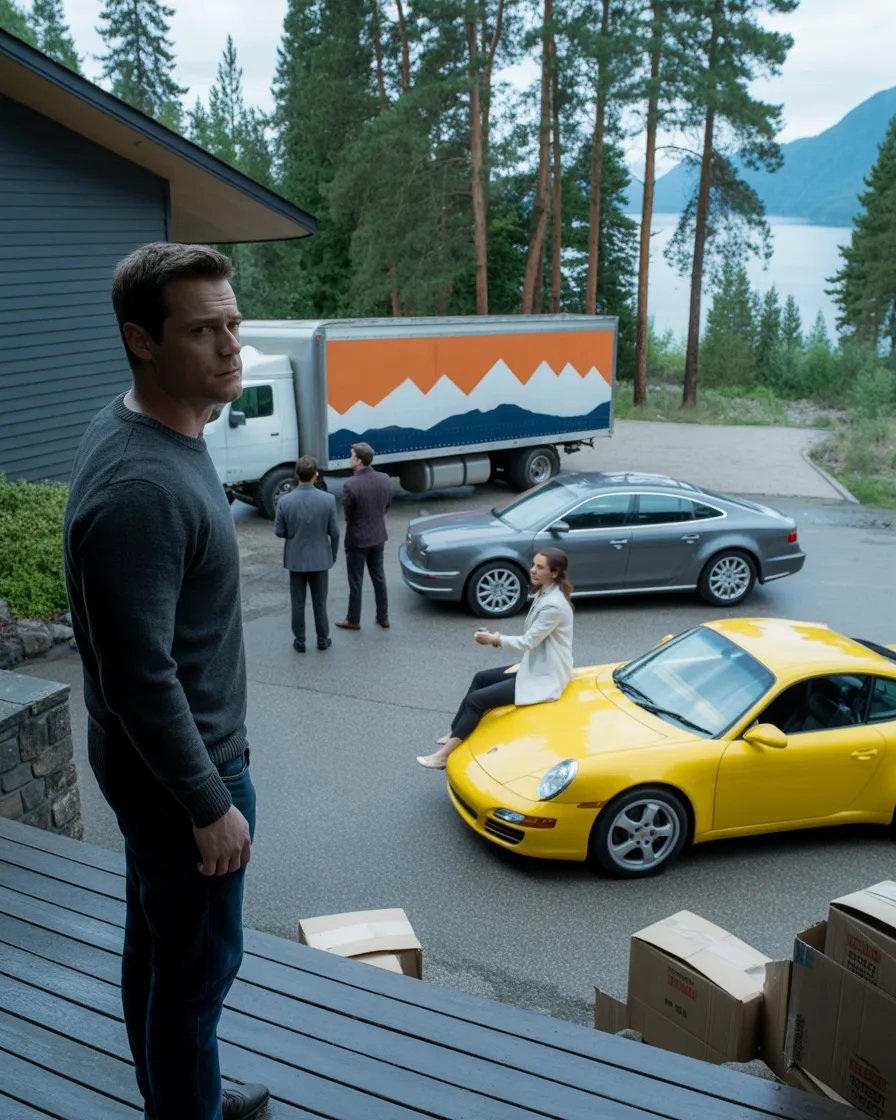
Bella’s yellow Porsche had appeared sometime in the last half hour, parked behind the U-Haul. She was sitting on the hood filing her nails during this exchange, apparently unbothered by the tableau of her parents’ ruin unfolding around her. “You are such a drama queen,” she announced without looking up.
“Just let them in. We’re family.”
“Tell me something,” I said. “You’re all technically homeless right now.
You’re allegedly broke, all three of you. And you drove here in a leased Porsche.”
Bella looked up. “It’s a business asset.
You wouldn’t understand, Rowan. You work for a paycheck. I’m building a brand.”
“You’re building a ruin,” I said.
“Mom and Dad’s ruin.”
“The crypto returns are coming in six months,” she said, with the confidence of someone who has never experienced a consequence. “We’re all going to be fine.”
“In six months,” I repeated. “So your plan was: sell the house, spend everything, sleep in my driveway, and wait six months for a crypto return that is not coming.”
“You know what, forget it,” she said.
“You’ve never believed in anything you couldn’t see on a blueprint.”
The sheriff’s cruiser came up the gravel drive then, blue lights reflecting off the wet pines. Deputy Miller stepped out. He’s been at county for years and knows the residents on the lake road.
He has been to my house for a barbecue. He looked at the soggy cardboard boxes on the lawn, the yellow Porsche, the broken gnome, and then at me on the porch. “Morning, Rowan,” he said.
“Morning, Jim,” I said. My father rushed forward in his respectable-citizen voice. “Officer, thank God.
My son is having some kind of breakdown. He’s locked us out of our vacation home. We moved in today and he won’t allow us to unload.”
Miller looked at me.
“Do you live here, sir?” he asked my father. “Yes, we just moved in. The truck is full of our things.”
“Do you have a lease or a deed?”
“We have a verbal agreement,” my father said.
“He agreed to let us stay, then changed his mind when we arrived.”
“That’s not true,” I said. “I haven’t spoken to them in three weeks. They arrived uninvited last night.
They have never been inside. They have no keys, no mail here, no residency of any kind.”
Miller nodded slowly. “If you haven’t been inside and the owner denied you entry, there’s no residency established.
The owner has the right to refuse guests at any time.”
“We’re not guests,” Bella called from the hood of the Porsche. “We’re family.”
“Doesn’t matter under the law,” Miller said. He looked at the broken window, then at the shattered gnome on the grass.
“Rowan mentioned property damage.”
I handed him my phone and showed him the clips. Miller watched the footage of my father at the breaker box. Then the gnome being thrown.
He watched both twice. When he looked back up, the neighborly ease was gone from his expression. “Sir,” he said to my father, “did you cut the power to this residence?”
“I was trying to reset the breaker.”
“At eight-thirty in the evening?”
“The doorbell wasn’t working,” my father said.
“And the window?” Miller nodded toward the gnome. “He provoked me,” my father said. “I’m his father.
He was disrespecting me.”
“Being a parent doesn’t give you the right to break windows,” Miller said flatly. “Here is where we are. You have no legal right to be on this property.
I have evidence of vandalism and what may be an attempted unauthorized entry with that locksmith. You have two options. Option A, you load those boxes back in the truck and leave now.
Option B, I arrest Mr. Bain for vandalism and criminal mischief and the rest of you for criminal trespass. I need a decision.”
Absolute silence in the driveway.
Even the U-Haul seemed to hold its breath. Bella looked at her parents. “Are we getting arrested?” she asked, sounding more inconvenienced than frightened.
My father looked at me. For the first time since they arrived, the certainty was gone from his face. What replaced it was older and smaller.
He was looking for me to stop it. To say, it’s okay, Jim, let them stay, we’ll work it out. I met his eyes.
I thought about the basement clause in that handwritten contract. I thought about the three hundred dollars a month. I thought about the Porsche.
“Option A,” I said. My father’s shoulders dropped. The fight left him the way air leaves a room when a window opens.
“Fine,” he said. “We’re leaving. You happy?
You made your parents homeless.”
“You made yourselves homeless,” I said. “I’m just declining to be the shelter.”
The next thirty minutes were the most peculiar of my life. I watched my sixty-five-year-old father and my mother load soggy cardboard boxes back into the U-Haul while Deputy Miller stood with his arms crossed, watching.
Bella did not help. She sat in the Porsche, texting, managing her narrative elsewhere while her parents worked. When the last box was loaded and the truck door rolled shut, my father walked back to the porch one final time.
He did not look angry. He looked old. Older than I had ever seen him.
“You’re dead to us,” he said quietly. “Don’t call. Don’t come to Christmas.
You have no family.”
“I haven’t had a family for a long time, Dad,” I said. “I just had a role.”
He flinched as if I had said something physically painful. Then he turned and walked back to the sedan.
Bella revved the Porsche and peeled out of the driveway, gravel spraying. The U-Haul followed, lumbering down the drive through the pines and out of sight. Miller watched them go.
“You okay?”
“No,” I said honestly. “But I will be.”
“You want to file on the window?”
“No. Put a note in the file in case they come back.”
He nodded and drove away.
I was alone. The driveway was empty except for scraps of wet cardboard and the ceramic dust of the gnome. I went inside and locked the door.
I made coffee and stood at the kitchen window looking at the lake, which was dark and moving and completely indifferent to everything that had just occurred, the way large bodies of water always are. The family reaction was swift and scripted. By evening my phone was flooded with messages from aunts, uncles, and cousins I had not seen in a decade.
Joyce was in the hospital. I had left them on the street. I would die alone in that big house.
I did not reply to any of them. Instead I compiled the evidence into a Facebook post. The security footage.
The handwritten contract with its basement clause. Screenshots of Bella’s Porsche photo and her champagne toast, timestamped the same day my parents claimed to be destitute. The property record showing the six hundred and twenty thousand dollar sale price.
I wrote one paragraph: that they had sold their home for six hundred and twenty thousand dollars and given it all to Bella for a car and a cryptocurrency investment, then arrived at my property with a moving truck, demanded I relocate to my unfinished basement for three hundred dollars a month, and destroyed my window when I declined. I noted that anyone who wanted to support their plan was welcome to house them themselves. The hateful messages stopped within an hour.
Aunt Clara deleted her posts. My cousin Mike texted to apologize. He hadn’t known about the Porsche.
I learned later, through Henderson, who hears everything along the lake road, that they stayed two nights at a Motel 6 in town. Then the arithmetic of Bella’s investment scheme became undeniable even to them, and they had to return the Porsche, losing the deposit and the lease-break fee, another ten thousand dollars gone. They rented a double-wide trailer in a park twenty miles away.
It was all they could afford on what remained of the pension. Bella stayed with them for a week, then moved to Miami with someone she had met online to pursue modeling opportunities. She left the moment the money ran dry, which is the only move in her repertoire that had ever been predictable.
My father called a month later. I let it go to voicemail and listened once. He was not apologizing.
He was asking whether I had any furniture I was not using because the trailer had come unfurnished. I blocked the number. It has been six months.
The lake is frozen now, a sheet of white stretching to the horizon. I fixed the window. I replaced the ceramic gnome with a concrete one that is too heavy to throw.
I spend my evenings working by the fire with my dog at my feet. It is quiet here. Sometimes it is lonely.
I will not pretend otherwise. There is a specific kind of grief in understanding that your parents chose their certainties over their relationship with you, that the hurricane did not turn back because it missed you but because it needed something you had. Recognizing that does not make the grief smaller.
It just makes it clearer. But I look at the walls I built, at the beams I sanded, at the deed with only my name on it, at the bank account that is not being slowly dismantled to fund someone else’s delusions, and I understand something I could not have articulated before that Tuesday night. Family is not a suicide pact.
It is not a blank check with your name on it, held by whoever learned earliest how to make you feel that saying no meant you were cold, or selfish, or dead to them. You are allowed to close the door when the hurricane comes back. You are allowed to be the person who stays dry.
Poor planning on their part did not constitute an emergency on mine. And for the first time in thirty-six years, I am not anyone’s cushion, anyone’s extinguisher, anyone’s backup plan. I am just the man in the lake house, listening to the ice.
ADVERTISEMENT
