ADVERTISEMENT
He painted me as unstable, financially desperate, and unable to accept a father who had moved on to a new family. He submitted Victoria’s will and asked the court to recognize her as sole beneficiary of the Vance estate and all its holdings. Judge Harrison listened, made notes, and looked at our table.
“Your Honor. We object to the fraudulent document submitted by Mr. Davis.
We request admission of the decedent’s actual signed will, and we submit into evidence timestamped security footage, banking records, and an audio recording made legally by Mr. Vance in his own private residence.”
The particular stillness that fell over their half of the room was different from concentration. It was recognition. Mr.
Davis objected on discovery grounds. Judge Harrison overruled him. The materials had been delivered to his office that morning by encrypted courier.
Reporters wrote. Several people in the family section looked at Victoria with expressions they stopped bothering to moderate. Julian removed his sunglasses with hands that were not entirely steady.
He never said that. I never said that.”
Mr. Sterling continued. Photographs appeared on the courtroom screen in sequence, each one chosen for its clarity and its specificity.
Victoria at the study safe, documented by the interior camera she had no knowledge of. Julian’s transfers from the medical trust into Vance Ventures LLC, the amounts and dates mapped against the banking logs. The forensic analysis of the notary stamp on Victoria’s will, the notary in question provably on a cruise, out of state, on the date the document claimed to have been executed in our living room.
Sterling said, “we submit the final provision of Arthur Vance’s true will. The sealed bequest left for his widow.”
He held up the envelope. My father had pressed it into my hands in a hospital room that smelled like antiseptic and cut flowers, his fingers deliberate despite how thin they had become.
I had taken the envelope instead, held it against my chest on the drive home, and slept with it on the nightstand for three weeks before the day I handed it over in the back of a car in the rain. The courtroom went quiet enough that the rain against the stained-glass windows was audible. The court clerk broke the wax seal and removed the contents.
Victoria, I know exactly what you did. I know about the forged medical directive. I know about the stolen wire transfers.
I know about the fraudulent will you pressured me to sign while withholding my pain medication. I leave you this single brass key because you always wanted unfettered access to everything I owned. It opens the safety deposit box at First National Bank, which contains the hard copies, the original recordings, and the undeniable proof of your crimes.
I leave it to you so that you know, without question, that your own greed was your undoing. Victoria was on her feet before the clerk finished. The sound she made was not the controlled grief of the widow she had been performing.
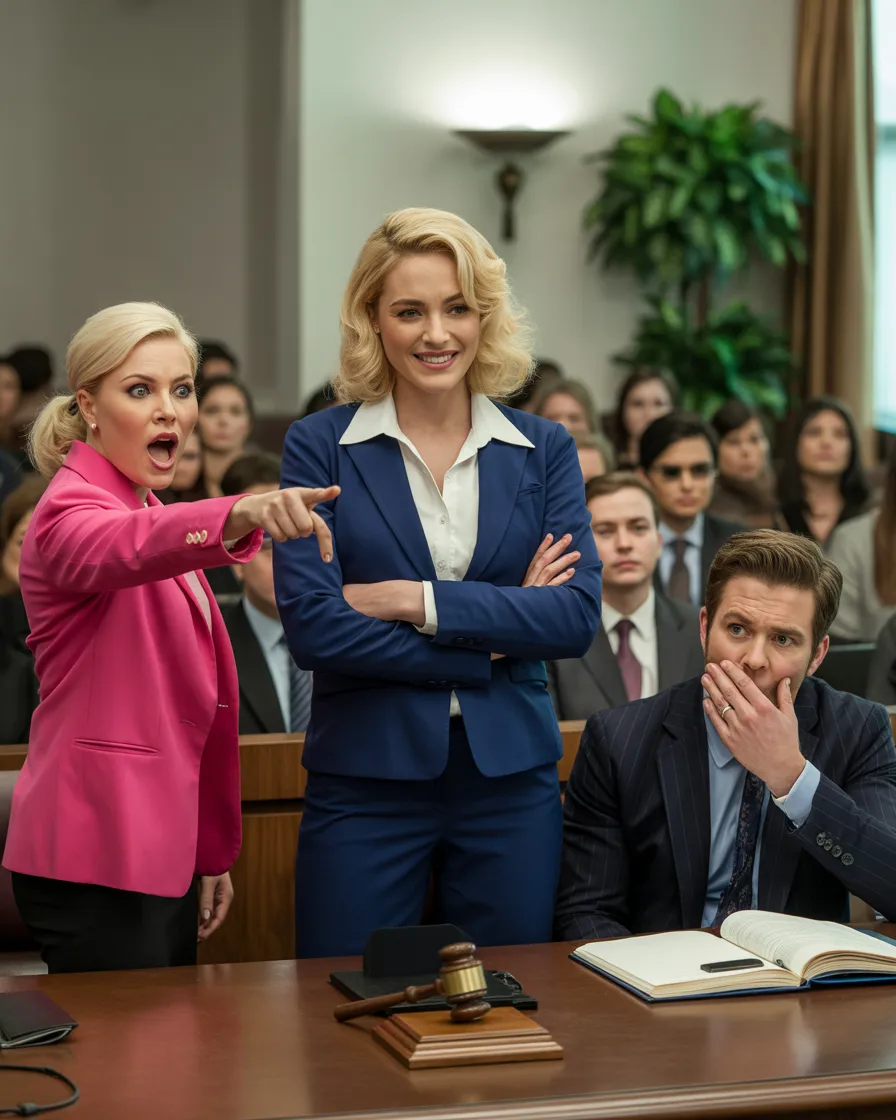
It was something rawer than that, the sound of a structure collapsing. “He loved me!” she said, pointing at me. “You poisoned him against me!
You manipulated him in his final days!”
She moved toward me. Two court officers moved faster. In the brief struggle, the string of white pearls at her throat caught on a badge and snapped.
The pearls scattered across the courtroom floor, bouncing and rolling and going quiet one by one in the corners. Judge Harrison’s ruling was swift and complete. The forged will was rejected and stricken from record.
The estate, the investment accounts, the controlling shares of Vance Logistics passed entirely to me. The court issued criminal referrals to the District Attorney covering fraud, elder financial abuse, forgery, and attempted coercion. Julian was arrested two days later in the driveway, handcuffed beside the vintage Mustang he had been loading with artwork and electronics.
He was charged with wire fraud and felony theft. Victoria lost the house she had thrown her parties in. She lost the money she had moved quietly into Julian’s accounts.
She lost the social standing she had spent five years acquiring. The Vance name, which she had tried to wear like a title, became a different kind of mark entirely. I did not sell the house.
I could not bear to let it leave entirely. My mother’s life was still somewhere in its walls, in the particular way the light moved through the western windows in the late afternoon, in the sound the third stair made when you stepped on it, in the smell of the library that had absorbed decades of her and my father’s reading. But I also understood that a house that size, preserved around grief and occupied by one person, would eventually become a different kind of problem.
Rooms that held too many memories and too few people can become suffocating rather than comforting. I had watched it happen to other people. So I did something with it.
I spent three months in conversations with Mr. Sterling, with my father’s financial trustees, with people who ran programs for students in circumstances I understood from a particular angle: students who had aged out of the foster system with nowhere to land when they needed somewhere most. The conversations were slow and detailed and sometimes difficult, because the legal and financial structures required to convert a private estate into a functioning residential scholarship program were more complicated than I had initially grasped.
But I had a law school education now, and I had Mr. Sterling, and I had the considerable resources of the Vance estate, which my father had spent forty years building into something that could support more than one person’s life. The house was refurbished.
The rooms were redone. The kitchen, which my father had redesigned when I was in middle school, was restocked and made available. The library, still holding the books Victoria had not gotten around to selling, was kept intact and opened.
Six students arrived in the first cohort. More were coming. Six months after the hearing, I stood on the wraparound porch again in spring light, the ancient oaks heavy with new leaves, my father’s watch warm and steady against my wrist.
The afternoon was mild and clear, the kind of day that makes the bad ones feel further away than they are. I thought about my father, who had spent his final weeks building the architecture of protection he would never see used. Who had recorded everything and sealed everything and prepared everything because he understood that the best thing he could leave me was not sentiment but preparation.
He had been right. He was usually right. A yellow taxi came up the long driveway.
The first student of the new term got out. She was nineteen, carrying everything she owned in one taped cardboard box, looking up at the columns of the house with the expression of someone trying to calculate whether she was actually allowed to be here, whether the good thing in front of her was real or whether some administrative error would surface in the next few minutes and correct itself. I walked down the steps.
I knew that expression from the inside. I had stood in the rain with a cardboard box of my own and understood exactly what it felt like to hold your whole life in your arms while someone informed you that the space you had believed was yours had been decided against you. I reached out and took one handle of the box.
She looked at me, uncertain. “You don’t have to be afraid,” I said. I held the front door open wide.
“This house is yours now.”
She stepped through the door. I followed her in. The house accepted both of us without ceremony, the way houses do when they have been occupied long enough to understand that people come and go and what endures is the structure that makes room for them.
I stood in the foyer for a moment with one hand on the frame my father had painted the summer I turned twelve, and I listened to the house begin to sound like itself again. Footsteps on the staircase he had restored. Doors opening in rooms where other doors had been closed too long.
The ordinary, necessary noise of people settling into a place they did not yet fully trust but were beginning to try. That sound was the last thing he had given me, and the best. Not the house itself, not the estate or the accounts or the Mustang Julian had tried to auction.
The ability to give the house forward to people who needed it. The ability to be the open door instead of the one standing in the rain. I went inside.
ADVERTISEMENT
